
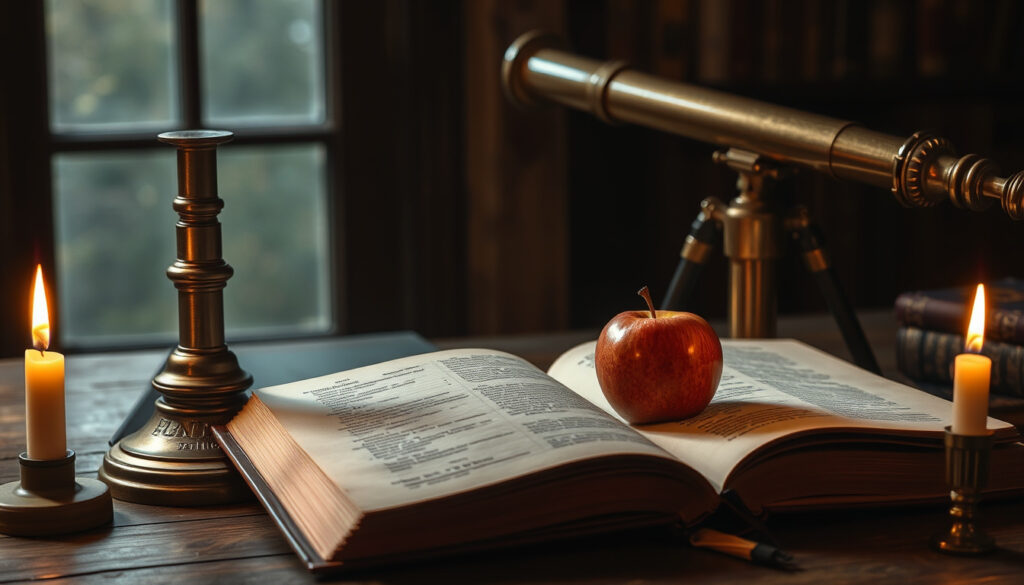
Sir Isaac Newton remains one of the most influential figures in the history of science. His work laid the foundation for classical mechanics, revolutionized our understanding of gravity, and helped shape modern physics and mathematics. From his three laws of motion to the development of calculus, Newton’s discoveries continue to be taught in classrooms around the world. This article provides a comprehensive look at his life, his major achievements, the famous apple story, and the questions that still surround his legacy.
Born in 1643 in Woolsthorpe, Lincolnshire, Newton was a mathematician, physicist, astronomer, and natural philosopher. His landmark book, Philosophiæ Naturalis Principia Mathematica (the Principia), first published in 1687, is widely regarded as one of the most important scientific works ever written. It unified celestial and terrestrial mechanics under a single set of mathematical laws, making Newton the central figure of the Scientific Revolution.
What is Isaac Newton Famous For?
Sir Isaac Newton
4 January 1643 (25 December 1642 Old Style)
31 March 1727 (20 March 1727 Old Style)
Laws of motion, universal gravitation, calculus, reflecting telescope
Newton’s fame rests on several groundbreaking contributions. Below are the key insights that define his legacy.
- Newton’s laws of motion underpin classical mechanics and remain fundamental in physics.
- His work on gravity was a turning point in the Scientific Revolution, unifying celestial and terrestrial mechanics.
- Newton developed calculus independently but contemporaneously with Leibniz, leading to a priority dispute.
- He was deeply interested in alchemy, theology, and biblical chronology—often overlooked in popular accounts.
- Newton never married and lived a largely solitary academic life.
- The apple anecdote is believed to be true in essence, but the “apple hitting his head” is likely a simplification.
| Fact | Details |
|---|---|
| Newton was born prematurely and survived. | His small size at birth was noted by his mother. |
| He was educated at the King’s School, Grantham, and later Trinity College, Cambridge. | He entered Cambridge in 1661. |
| During the Great Plague (1665‑66), he made major discoveries in calculus, optics, and gravity. | This period is often called his annus mirabilis. |
| He served as Lucasian Professor of Mathematics at Cambridge. | He held the chair from 1669 to 1696. |
| He was Master of the Mint and president of the Royal Society. | His role at the Mint involved combating counterfeiting. |
| Newton was knighted by Queen Anne in 1705. | He was the first scientist to receive a knighthood for his work. |
| He died in his sleep and was buried in Westminster Abbey. | His tomb is a prominent monument in the abbey. |
What Did Isaac Newton Discover?
Newton’s discoveries span mathematics, optics, mechanics, and astronomy. They fundamentally changed how people understood the physical world.
The Three Laws of Motion
Newton’s first law describes inertia: objects continue in their state of rest or uniform motion unless acted on by a net force. His second law relates force, mass, and acceleration. His third law states that every action has an equal and opposite reaction. These laws first appeared in the Principia and remain central to physics, as documented by Britannica.
The Law of Universal Gravitation
Newton’s theory of gravity holds that two objects attract each other with a force proportional to their masses and inversely proportional to the square of the distance between their centers. This work unified celestial and terrestrial motion, showing that falling apples and planetary orbits could be explained by the same law, according to Wikipedia.
Calculus and the Method of Fluxions
Newton is widely credited as an original discoverer of infinitesimal calculus, though his priority was historically disputed by Leibniz. He called his approach the “method of fluxions,” developed in the 1660s before the publication of Leibniz’s version, as noted by the Ohio State University biography.
Optics and the Nature of Light
In optics, Newton showed that white light is a mixture of colors and made important contributions to the science of light and color. His experiments with prisms demonstrated that light could be separated into a spectrum. This work is detailed in Biography.com.
Contributions to Mathematics
Newton also helped formulate the generalized binomial theorem and other mathematical results in the mid‑1660s, further expanding the tools available to mathematicians and scientists.
Newton’s invention of calculus was independent of Leibniz, but the two men never collaborated. The dispute over priority affected European mathematics for decades.
Isaac Newton Biography: Education, Life, and Death
When and Where Was Newton Born?
Newton was born on 4 January 1643 (often given as 25 December 1642 Old Style) in Woolsthorpe, Lincolnshire, England. He was a premature baby, and his survival was uncertain at first.
Education and Early Studies
He attended school in Grantham and then entered Trinity College, Cambridge in 1661, according to Britannica. He graduated in 1665, and after that period his private study years became one of the most productive phases of his life. During the academic interruption caused by the plague, he developed major ideas in calculus, optics, and gravitation while at Woolsthorpe.
Did Isaac Newton Have a Wife?
Newton never married. The sources provided do not identify a wife because there was none. He is believed to have had no romantic partners, and he lived a largely solitary life focused on his work.
How Did Isaac Newton Die?
Newton died in London on 20 March 1727 (Old Style; 31 March 1727 New Style). He passed away in his sleep, likely from natural causes, possibly complications from a chronic illness. He was buried in Westminster Abbey, as noted in the YouTube documentary SciTube video.
Religious Views
Newton was a devout but unorthodox Christian. He privately rejected the doctrine of the Trinity and held Arian or unitarian beliefs, which he did not publicly declare. His theological studies were extensive but remained largely secret during his lifetime.
Many assume Newton was a conventional Anglican, but his private writings reveal deeply heterodox views that he kept hidden for fear of persecution.
The Story of Isaac Newton and the Apple
The famous story says an apple falling from a tree helped inspire Newton’s thinking about gravity. According to Biography.com, there is no evidence the apple hit him on the head, but he did see an apple fall and used it as a prompt to think about why objects fall straight down. The anecdote is best understood as a symbolic illustration of his reasoning, not a fully verified historical event.
Voltaire later popularized the version with the apple hitting Newton’s head, but Newton’s own accounts only mention observing an apple fall. The core event is considered plausible but not confirmed in detail.
The apple story appears in writings by Newton’s contemporaries, including William Stukeley, who recorded that Newton told him the observation occurred while he was sitting under a tree.
What Is the Timeline of Isaac Newton’s Life and Achievements?
- 1643: Born in Woolsthorpe, Lincolnshire.
- 1661: Admitted to Trinity College, Cambridge.
- 1665: Begins work on calculus, optics, and gravity during the plague.
- 1669: Becomes Lucasian Professor of Mathematics.
- 1672: Elected Fellow of the Royal Society.
- 1687: Publishes Philosophiæ Naturalis Principia Mathematica.
- 1696: Appointed Warden of the Royal Mint.
- 1703: Elected President of the Royal Society.
- 1704: Publishes Opticks.
- 1705: Knighthood by Queen Anne.
- 1727: Dies in London; buried in Westminster Abbey.
What Is Certain and What Remains Uncertain About Newton?
| Established Information | Information That Remains Unclear |
|---|---|
| Newton discovered the law of universal gravitation. (Certain – widely accepted, documented in Principia.) | The apple story is literally true: an apple fell on his head inspiring gravity. (Uncertain – Newton’s own account mentions seeing an apple fall, but the “hit on head” detail comes from later embellishments by Voltaire and others.) |
| Newton invented calculus. (Certain but nuanced – independent invention, debate with Leibniz over priority.) | — |
| Newton rejected the doctrine of the Trinity. (Certain – he privately held Arian or unitarian views, though he kept them secret.) | — |
| Newton never married. (Certain – no evidence of marriage or known romantic partners.) | — |
What Was the Broader Impact of Newton’s Work?
Newton’s contributions came during the Scientific Revolution, building on earlier work by Galileo and Kepler. He integrated prior knowledge into a coherent mathematical framework, and his Principia became a model for scientific inquiry. The laws of motion and universal gravitation remained unchallenged until the advent of Einstein’s relativity and quantum mechanics. Newton also pursued alchemy and theology, which were considered legitimate branches of natural philosophy in his era.
His legacy extends beyond physics and mathematics. He helped define the scientific worldview that would dominate Western thought for centuries. For students preparing for UK exams, Newton’s laws and calculus are core components of the curriculum. You can find relevant study materials in the Life in UK Test – Complete Guide for 2025 and the GCSE Results Day 2026 – Date, Times and Online Access Guide.
What Are the Key Sources and Quotes About Newton?
“If I have seen further it is by standing on the shoulders of Giants.”
Letter to Robert Hooke, 1675
“I can calculate the motion of heavenly bodies, but not the madness of people.”
Attributed, possibly apocryphal
“Hypotheses non fingo” (I frame no hypotheses).
Principia, 1687 (General Scholium)
Primary sources for Newton’s life and work include his own writings, the comprehensive Wikipedia article, the authoritative Britannica entry, and the biography from the Isaac Newton Institute. The BBC Teach video offers a short educational overview.
Why Does Newton’s Work Still Matter Today?
Newton’s laws are still taught at every level of physics education because they accurately describe the motion of everyday objects and celestial bodies under most conditions. While relativity and quantum mechanics have shown the limits of Newtonian physics, his work remains the foundation upon which modern physics was built. Understanding Newton is essential for anyone exploring the history of science or preparing for exams that include classical mechanics and calculus. For further reading, the Life in UK Test – Complete Guide for 2025 offers context on British historical figures.
Frequently Asked Questions
Did Isaac Newton have a wife?
No, Isaac Newton never married and had no known children.
How did Isaac Newton die?
Newton died in his sleep on March 31, 1727 (OS March 20) at age 84. The cause is often attributed to natural causes, possibly complications from a chronic illness.
Where did Isaac Newton study?
Newton studied at Trinity College, Cambridge, beginning in 1661. He later became a professor there.
What was Isaac Newton’s religion?
Newton was a devout but unorthodox Christian. He privately rejected the doctrine of the Trinity and held Arian or unitarian beliefs, which he did not publicly declare.
Did Newton really see an apple fall?
According to Newton’s own recollections, he saw an apple fall while thinking about gravity. The popular version (apple hitting his head) is a later embellishment published by Voltaire. The core event is considered plausible but not fully verified.
What is Isaac Newton’s most famous invention?
Newton did not invent in the sense of devices, but his major contributions include the laws of motion, universal gravitation, the reflecting telescope, and the mathematical discipline of calculus.

Jack Thomas Clarke Thompson is a staff writer for PopCultureDaily.co.uk, covering entertainment news, film, television, streaming and celebrity culture. He works under Editor-in-Chief Harriet Winslow and Managing Editor Lucas Bennett, following the newsroom standards for sourcing, verification and fact-checking set out in our editorial policies.