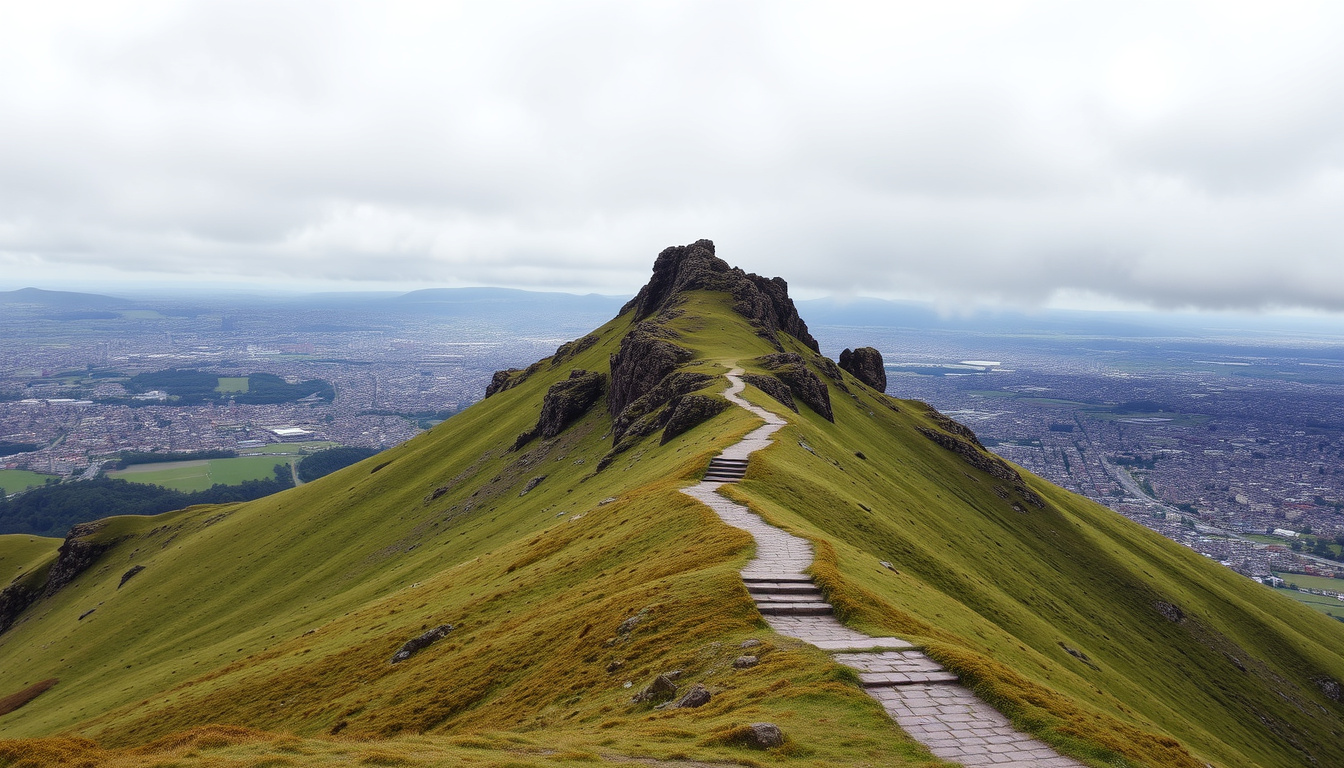
Rising 251 metres above sea level in the heart of Edinburgh, Arthur’s Seat is the centrepiece of Holyrood Park and one of the most recognisable landmarks in Scotland. It is the remains of a 350-million-year-old extinct volcano, a site that shaped the early science of geology, and a destination that attracts walkers, history enthusiasts, and visitors from around the world. The park is open year-round, free to access, and offers a range of walking routes, parking options, and views that stretch across the city to the North Sea.
Arthur’s Seat is not just a hill. It is a geological relic, a place of disputed origins, and a living part of Edinburgh’s landscape. Understanding what it is, how it formed, and how to visit it requires looking at several layers of evidence, from the volcanic rock beneath your feet to the stories that have shaped its name.
Why is it called Arthur’s Seat? The Legend and the Name
The name “Arthur’s Seat” is first recorded in 1562, but its origin remains a matter of debate. No single explanation has been universally accepted, and multiple theories compete for plausibility.
- Arthur’s Seat is a remnant of a 350-million-year-old extinct volcano, not just a hill.
- The origin of the name is uncertain, linked to either the legendary King Arthur or a misunderstanding of Scottish Gaelic.
- It offers the best panoramic view of Edinburgh city, the Firth of Forth, and the Lothians.
- Arthur’s Seat is part of a larger parkland (Holyrood Park) with multiple other hills and ancient sites.
- In 2024-2025, minor wildfires (often quickly controlled) have occurred on the hill, requiring visitor caution.
| Category | Details |
|---|---|
| Location | Holyrood Park, Edinburgh, Scotland EH8 8HG |
| Status | Extinct volcano (does not erupt) |
| Height | 251 m (823 ft) |
| Climb Time | 30 min (short walk) to 1 hour (moderate hike) |
| Difficulty | Easy to Moderate |
| Route Options | 3 main routes (Salisbury Crags, Dunsapie Loch, Radical Road) |
| Parking | Paid parking at Broad Road (limited spaces) |
| Public Transport | Bus (Lothian Buses: 6, 35, 36) or Edinburgh Waverley Train Station (15-min walk) |
| Hours | Holyrood Park open 24 hours; Arthur’s Seat accessible anytime |
| Entry Fee | Free |
The King Arthur Legend
The most widespread explanation links the name to the legendary King Arthur. According to this theory, the hill was named after the mythical ruler, possibly because its shape resembles a throne or because of an association with Arthurian tales that spread across Britain. The name is first recorded in 1562, but the connection to Arthur remains speculative and is not supported by any medieval document that directly ties the hill to the king.
Prince Arthur, Duke of Edinburgh Debate
Another theory proposes that the hill was named after Prince Arthur, the son of James IV of Scotland, who was created Duke of Edinburgh in the early 16th century. However, the earliest recorded use of the name predates any known connection to Prince Arthur, and the evidence for this link is considered weaker than the King Arthur theory.
Alternative etymologies
Some sources suggest that the name may derive from the Scottish Gaelic “Àrd-na-said,” meaning “height of the arrow” or “height of the stones.” This interpretation is not widely accepted, but it reflects the uncertainty that surrounds the name’s origin. The lack of a definitive answer means that visitors and historians continue to debate the meaning of the name today.
Is Arthur’s Seat an Extinct Volcano? Geology and Formation
Arthur’s Seat is widely described as an extinct volcano formed during the Carboniferous period, with volcanic activity dated to roughly 340–350 million years ago. The Geological Society of London lists it among its “100 Great Geosites,” and the British Geological Survey describes the volcano as active in the Dinantian, early Carboniferous, with its first eruption products marking the top of the Cementstone Group.
The 350 Million Year Old Volcano
Geological sources place the start of volcanic activity around the beginning of the Carboniferous, when lava erupted at Arthur’s Seat and spread across the landscape. The summit and surrounding topography preserve evidence of vents and volcanic features, including the remains of the central volcanic structure. Erosion and glaciation removed much of the volcano, but the remaining hills and exposed rocks allow visitors to see part of the volcanic structure.
The exposed rocks on the slopes of Arthur’s Seat and Salisbury Crags show clear evidence of both igneous and sedimentary formations. The Geological Society notes that James Hutton used observations at these locations to support his ideas about the Earth’s processes, recognising that different rock types had formed at different times by different processes.
Glacial Sculpting and the ‘Lion’ Shape
During the last Ice Age, around 20,000 years ago, glaciers carved the hill into its current form. The distinctive shape that some observers compare to a resting lion is the result of this glacial sculpting, which removed softer rock and left the harder volcanic core exposed.
How to see the volcanic rock
The BGS Earthwise resource describes four geology excursions in the area: Salisbury Crags, Whinny Hill, Lion’s Head and Lion’s Haunch Vents, and Calton Hill. These walks allow visitors to see the volcanic structure up close, including the remains of vents and lava flows that are visible in the exposed rock faces.
What is the Best Walk or Route up Arthur’s Seat?
Several sources describe a network of signed routes around Holyrood Park, including the green, red, and yellow routes, plus alternative pink and black routes on some maps. The main, commonly used circuit is often described as a clockwise walk around Queen’s Drive, with paths leading from Holyrood Palace and the Parliament area toward the summit.
The Easy Route: Salisbury Crags to the Summit
The route via Salisbury Crags is considered the gentlest option. It follows a well-maintained path that rises gradually, offering wide views over the city without the steep sections found on other routes. This is the route most often recommended for beginners and families with children.
The Direct Route: From the Holyrood Park Gate
Starting from the Holyrood Park gate near the Scottish Parliament, a direct path leads to the summit in approximately 30 minutes. This is the shortest route but includes steeper sections. One video guide reports a 30-minute ascent from the Holyrood car park to the summit, while other sources estimate a round trip of about 2 hours depending on pace and stops.
The Circular Walk: Exploring the Whole Park
For those who want to see more of Holyrood Park, a circular walk around Queen’s Drive takes in the full perimeter of the park and passes Dunsapie Loch, St. Anthony’s Chapel ruins, and the cliffs of Salisbury Crags. This route is longer but offers a more complete experience of the landscape.
One guide notes that the western red route (Radical Road) is currently closed to visitors. Before setting out, check the latest path conditions, as temporary closures can occur due to maintenance, weather, or fire risk.
Interactive Arthur’s Seat Map
The most useful maps for planning your walk are the Holyrood Park route materials referenced in route guides and geology walk documents. These show the park’s trails and alternate loops. The Ordnance Survey map also provides a detailed reference for the area.
Where is Arthur’s Seat and How Do I Get There?
Arthur’s Seat is located in Holyrood Park, Edinburgh, postcode EH8 8HG. It is situated just east of Edinburgh’s city centre, within walking distance of the Royal Mile, Holyrood Palace, and the Scottish Parliament.
Address and Parking
A car park near Holyrood Palace and Queen’s Drive is repeatedly mentioned as a starting point. One guide says this car park costs £1 per hour on weekdays and is free on weekends. Another option is a small car park on the east side, off Queen’s Drive near Duke’s Walk, and a free car park at the Meadowbank entrance with about 20 spaces. Sources also mention parking at Dunsapie Loch as a free option. However, one travel guide states that road access in Holyrood Park is closed to motor vehicles on Saturdays and Sundays, which affects parking and driving access.
Public Transport (Bus and Train)
Lothian Buses routes 6, 35, and 36 stop near Holyrood Park. Edinburgh Waverley train station is about a 15-minute walk from the park entrance, making Arthur’s Seat easily accessible from anywhere in the city.
Holyrood Park Opening Times
Holyrood Park is open year-round and free to access. Because the park is open air, practical opening times are usually limited by daylight, weather, or safety closures rather than fixed gate hours.
Best Times to Visit
One guide recommends visiting between April and October for the best conditions, while noting that winter visits are still possible if you start early. The summit offers wide views over Edinburgh, the surrounding coast, and in some descriptions the North Sea. Sunrise and sunset are particularly popular times for photography.
Road access in Holyrood Park is closed to motor vehicles on Saturdays and Sundays. If you plan to drive, check the current access policy before your visit. Public transport or walking from the city centre are reliable alternatives on weekends.
Was There a Fire on Arthur’s Seat? Recent Events and Safety
Reports of Wildfires on Arthur’s Seat
A 2024 wildfire was reported on Arthur’s Seat, and sections were temporarily closed for safety. This makes fire precautions especially important in dry or windy weather, when access restrictions may be imposed. Sources do not provide a full official fire-safety policy, but they do show that temporary closures can happen after wildfire incidents and that visitors should expect restrictions during elevated fire risk.
What to Do in an Emergency
Because Arthur’s Seat is grass-covered and exposed, avoiding flames, barbecues, and discarded cigarettes is particularly important. If you see a fire, move to a safe area and contact the emergency services. The park’s location within the city means that emergency response times are generally short, but the terrain can make access difficult for vehicles.
Weather and Ground Conditions
The path can be muddy after rain, and the exposed summit is subject to strong winds at any time of year. Sturdy walking shoes or trainers are recommended, along with layers and a waterproof jacket. Check the weather forecast before setting out, and be prepared to turn back if conditions deteriorate.
A Timeline of Arthur’s Seat: From Volcano to Icon
- ~350 million years ago – Volcanic eruption creates Arthur’s Seat.
- ~20,000 years ago – Ice Age glaciers shape the hill into its current form.
- ~2,000 years ago – Iron Age hillforts built on Arthur’s Seat (evidence remains).
- 12th–14th centuries – First written references to “Arthur’s Seat” appear (name debated).
- 1830s – Holyrood Park officially enclosed as a Royal Park.
- 1999 – Scottish Parliament building opens at the foot of the hill.
- 2018 – Arthur’s Seat designated as a Scheduled Ancient Monument.
- 2024–2025 – Minor wildfires reported; event-specific safety advisories issued.
What Is Known and What Remains Uncertain About Arthur’s Seat?
| Established Information | Information That Remains Unclear |
|---|---|
| Arthur’s Seat is an extinct volcano, not a dormant one. | The exact origin of the name “Arthur’s Seat” is debated (King Arthur vs. Gaelic “Àrd-na-said”). |
| The hill is 251 metres high. | The number of daily visitors is not officially tracked by public sources. |
| It is located in Holyrood Park, Edinburgh, Scotland. | Autopsy-level archaeological details of the Iron Age forts are still being investigated. |
| It is free and open 24/7 to the public. |
Why Arthur’s Seat Matters: Geology, History, and the City
The name matters because it is the most common question tourists ask, yet no single source gives a balanced answer that presents both the King Arthur and the Prince Arthur perspectives alongside the Gaelic alternative. Geologically, Arthur’s Seat is a rare example of an intra-city extinct volcano, comparable to Castle Rock in Edinburgh. The absence of a ticket system makes it accessible but has led to issues with overcrowding and litter. Recent fires highlight the increasing need for visitor education about fire safety and park conservation. For those interested in the city’s royal connections, the story of Edward VII – The Peacemaker King of the Edwardian Era offers a broader look at the monarchy’s role in Edinburgh’s heritage.
Credible Sources on Arthur’s Seat
“The hill gives its name to the Arthur’s Seat volcanic formation, which has been described as a ‘classic example of a volcanic plug’.”
– Wikipedia – Arthur’s Seat
“Dominated by the iconic Arthur’s Seat, this ancient volcanic site offers stunning views of the capital.”
– Historic Environment Scotland
“Arthur’s Seat is the highest of a group of hills, formed from the remains of a volcano, that make up Holyrood Park.”
– Walkhighlands
What to Take Away Before You Visit
Arthur’s Seat is a free, accessible, and geologically significant landmark that offers one of the best viewpoints in Edinburgh. The standard walking routes are suitable for most visitors, but check for path closures and fire risk before you go. For a broader look at Edinburgh’s history, you might also enjoy reading about James Robertson Justice – Life, Career, Cause of Death, a figure connected to the city’s cultural and royal heritage.
Frequently Asked Questions About Arthur’s Seat
Is Arthur’s Seat safe for children?
Yes, the standard walking routes (e.g., Salisbury Crags path) are suitable for children, but supervision is required near cliffs and loose rocks.
Can I walk my dog on Arthur’s Seat?
Yes, dogs are allowed in Holyrood Park but must be kept on leads near livestock and on paths.
What should I wear to climb Arthur’s Seat?
Sturdy walking shoes or trainers are recommended. The path can be muddy after rain. Layers and a waterproof jacket are advisable.
Is there a café or toilet near Arthur’s Seat?
Yes, the Holyrood Park Lodge (near the main entrance) has a café, toilets, and information point.
Can I cycle up Arthur’s Seat?
Cycling is permitted on some paths in Holyrood Park, but the summit is best reached on foot due to steep sections.
How long does it take to climb Arthur’s Seat?
Summit times vary by route. The direct path from the Holyrood car park takes about 30 minutes, while a round trip on the longer circular walk can take up to 2 hours.
Is Arthur’s Seat suitable for beginners?
Yes, the Salisbury Crags route is easy and well-maintained, making it suitable for beginners and casual walkers. The steeper direct routes are more challenging.
What are the views like from the top?
The summit offers panoramic views over Edinburgh, the Firth of Forth, the Lothians, and on clear days the North Sea.
Is Arthur’s Seat free to visit?
Yes, Holyrood Park and Arthur’s Seat are free to access at any time. No ticket or booking is required.
Can I visit Arthur’s Seat in winter?
Yes, winter visits are possible if you start early and dress appropriately. The best conditions are from April to October, but the hill is open year-round.

Jack Thomas Clarke Thompson is a staff writer for PopCultureDaily.co.uk, covering entertainment news, film, television, streaming and celebrity culture. He works under Editor-in-Chief Harriet Winslow and Managing Editor Lucas Bennett, following the newsroom standards for sourcing, verification and fact-checking set out in our editorial policies.