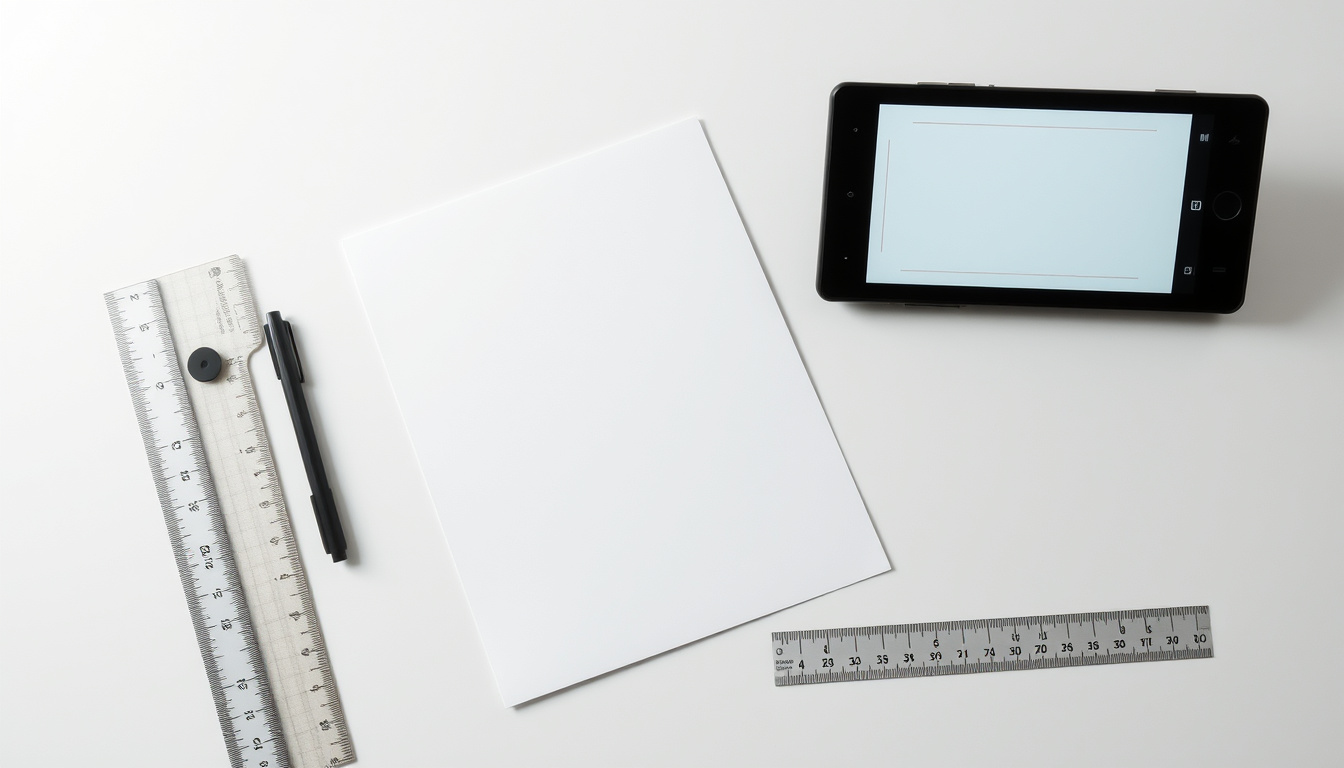

A4 paper measures 210 × 297 mm (21 × 29.7 cm or 8.27 × 11.69 inches), defined by the ISO 216 standard with an aspect ratio of 1:√2, making it one-sixteenth the area of A0. It is the most common paper size globally for documents, printing, and reports.
Understanding A4 dimensions matters whether you’re designing documents, setting up print layouts, or comparing paper sizes across regions. The A4 format serves as the basis for most international paper standards, adopted by virtually every country except the United States and Canada.
This guide provides precise measurements in all relevant units, from metric to imperial, plus pixel equivalents at common resolutions. You’ll also find comparisons to related sizes and practical context for everyday use.
What are the standard dimensions of A4 paper?
A4 is precisely defined by the ISO 216 international standard, which governs the A-series paper sizes used across most of the world. The dimensions remain consistent regardless of where the paper is produced, ensuring documents print correctly across borders and systems.
(21 × 29.7 cm)
(0.69 × 0.98 ft)
Key facts about A4 dimensions
- A4 covers exactly 1/16 of a square meter (0.06237 m²), derived from A0 halved four times lengthwise
- The 1:√2 aspect ratio (approximately 1:1.414) ensures that folding or cutting parallel to the shorter edge always yields two identical sheets
- A4 is slightly narrower but taller than US Letter (8.5 × 11 inches), measuring 215.9 × 279.4 mm
- The format became globally standardized through ISO 216, adopted internationally since 1975
- Pixel dimensions vary based on output resolution—no fixed pixel size exists without specifying DPI
- Every A-series size halves the previous size’s area, making scaling predictable and consistent
- A4 serves as the everyday standard for letters, reports, brochures, and academic documents worldwide
A4 dimensions snapshot
| Unit | Width | Height | Notes |
|---|---|---|---|
| Millimeters | 210 | 297 | ISO 216 standard definition |
| Centimeters | 21 | 29.7 | Metric equivalent |
| Inches | 8.27 | 11.69 | Often rounded to 8.3 × 11.7 |
| Feet | 0.69 | 0.98 | Less commonly referenced |
| Pixels (300 DPI) | 2480 | 3508 | Standard print quality |
What size is A4 in cm and mm?
The metric measurements for A4 form the basis of the international standard. In millimeters, A4 measures exactly 210 × 297 mm. Converting to centimeters gives 21 × 29.7 cm, which is how most of the world refers to this paper size daily.
These precise dimensions originate from the A0 size, which was defined as one square meter (841 × 1189 mm). Each halving of the sheet preserves the aspect ratio, meaning A4 is created by folding A3 in half lengthwise—a process that can be repeated indefinitely without losing proportion.
The exact measurements of 210 × 297 mm (21 × 29.7 cm) are mandated by ISO 216. Any slight variation in production would technically produce non-standard paper, though minor tolerances exist in manufacturing.
The 1:√2 aspect ratio embedded in these measurements means that A4 maintains its proportions whether scaled up to A3 or down to A5. This mathematical relationship, first proposed by Georg Lichtenberg in 1786, ensures that graphic designers and printers can rely on consistent results across all A-series formats.
A4 size in inches and feet
Imperial measurements matter for those working with US-standard equipment or materials. A4 measures 8.27 × 11.69 inches when using the precise figures, though many sources round these to 8.3 × 11.7 inches for convenience.
Converting to feet yields approximately 0.69 × 0.98 ft, measurements rarely used in practice but useful for certain international shipping or architectural contexts where feet are the primary unit.
When comparing to the US Letter format (8.5 × 11 inches or 215.9 × 279.4 mm), A4 is about 6 mm narrower and 18 mm longer. This difference becomes apparent when printing US documents on A4 paper or vice versa, potentially causing clipped margins or cropped content if not accounted for in design settings.
Why imperial measurements differ slightly
The slight discrepancy between precise inches (8.27 × 11.69) and rounded figures (8.3 × 11.7) reflects the mathematical challenge of converting metric units to imperial ones. The underlying ISO 216 standard uses millimeters as its base unit, so imperial values are necessarily conversions that lose some precision.
What size is A4 in pixels?
Pixel dimensions depend entirely on the resolution setting, measured in dots per inch (DPI) for print or pixels per inch (PPI) for screen display. Unlike physical measurements, pixels are not fixed—there is no standard A4 pixel size without specifying the resolution context.
For high-quality print production, the industry standard is 300 DPI, yielding 2480 × 3508 pixels. This resolution provides sharp, professional results for documents, brochures, and marketing materials.
| DPI/PPI | Pixels (Width × Height) | Primary Use Case |
|---|---|---|
| 72 | 595 × 842 | Web and screen display |
| 96 | 794 × 1123 | General screen viewing |
| 150 | 1240 × 1754 | Newspapers, flyers, drafts |
| 300 | 2480 × 3508 | High-quality print output |
| 600 | 4960 × 7016 | Professional posters, fine art |
| 1200 | 9920 × 14032 | Ultra-high resolution printing |
For everyday document printing, 300 DPI represents the minimum threshold for professional-quality output. Lower resolutions like 72 or 96 DPI work for screen display but appear pixelated when printed. Always match your DPI to your intended output method.
Minor variations exist across sources—some cite 2481 × 3507 pixels at 300 DPI due to rounding differences during calculation. For most practical purposes, 2480 × 3508 pixels provides sufficient accuracy.
How does A4 compare to A3 and A5 sizes?
The ISO 216 A-series uses a logical progression where each size halves the area of the previous format. Understanding these relationships helps when selecting paper sizes or scaling documents for different purposes.
| Format | Dimensions (mm) | Dimensions (cm) | Dimensions (inches) | Relative to A4 |
|---|---|---|---|---|
| A3 | 297 × 420 | 29.7 × 42 | 11.7 × 16.5 | 2× larger |
| A4 | 210 × 297 | 21 × 29.7 | 8.27 × 11.69 | Reference size |
| A5 | 148 × 210 | 14.8 × 21 | 5.8 × 8.3 | Half the area |
A4 fits the ISO 216 A-series, where each size halves the area of the previous one when folded parallel to the shorter edge. This creates predictable scaling for printing and design work.
A4 compared to common photo sizes
A standard 6×4 photo (152.4 × 101.6 mm or 6 × 4 inches) is considerably smaller than A4 and fits easily on an A4 sheet with substantial margins. Unlike ISO paper sizes, photo prints follow different standards and are not directly comparable to the A-series.
When converting measurements between systems, understanding these proportional relationships helps avoid common sizing mistakes in printing and design projects.
The history and ISO 216 standard
The mathematical foundation for A-series paper sizes traces back to Georg Lichtenberg, who proposed the √2 aspect ratio in 1786. This ratio ensures that each size maintains proportional relationships when scaled, a property unique among paper formats.
Walter Portsmann formalized these ideas as DIN 476 in Germany during 1922, establishing the first national standard for the A-series. The format gained international recognition when it became ISO 216 in 1975, adopted by most countries worldwide.
The United States and Canada remain notable exceptions, continuing to use Letter and Legal formats based on different historical measurements. This divergence creates occasional challenges for international document exchange and printing.
While ISO 216 defines A4 precisely, practical paper dimensions may vary slightly between manufacturers within acceptable tolerances. Always verify critical dimensions with your specific paper supplier when precision matters.
Common uses for A4 paper
A4’s balanced proportions make it ideal for everyday printing needs. The format serves as the standard for business correspondence, academic papers, government documents, and most printed materials outside North America. Professional printing shops rely on A4 for brochures, magazines, and bound reports.
The size accommodates both text-heavy documents and graphic designs effectively, with sufficient width for standard margins and comfortable reading layout. This versatility explains why A4 became the de facto international standard for most business and educational purposes.
Timeline of the A-series standard
- – Georg Lichtenberg proposes the √2 aspect ratio for optimal paper proportions
- – DIN 476 standard established in Germany, formalizing the A-series
- – ISO 216 adopts the A-series as an international standard
The format’s logical mathematical basis and practical dimensions led to gradual global adoption. Today, A4 serves as the primary paper size for virtually all countries outside North America, making it the closest thing to a universal document format.
Standardized facts and remaining variations
| Established information | Context or clarification |
|---|---|
| A4 measures exactly 210 × 297 mm | Defined precisely by ISO 216 |
| Aspect ratio is 1:√2 (≈1:1.414) | Mathematically exact, constant across all A-sizes |
| A4 is 1/16 of a square meter | Derived from A0 definition |
| Pixel dimensions vary by DPI | No fixed pixel size without resolution context |
| Minor rounding variations exist | Some sources cite 2481 × 3507 px instead of 2480 × 3508 |
Physical dimensions are precisely defined and universally consistent. Digital pixel values depend entirely on resolution settings, with no single correct answer. Manufacturing tolerances allow minor physical variations in practice.
Where to find authoritative sources
Several organizations provide reliable reference information on A4 dimensions and ISO 216 standards. Wikipedia’s International Standard Paper Sizes article offers comprehensive technical details with citations to primary sources.
The A series of paper sizes is based on a unique aspect ratio of the square root of two, approximately 1:1.4142. This ratio is particularly convenient for paper sizes because each size in the series is precisely half of the next size, parallel to the shorter side.
— ISO 216 Standard Documentation
The Adobe Creative Cloud design resource provides practical context for using A4 in professional design applications, while dedicated paper size databases offer detailed specifications and conversion tools.
Summary
A4 paper measures exactly 210 × 297 mm (21 × 29.7 cm), with imperial equivalents of 8.27 × 11.69 inches. The ISO 216 standard defines these precise dimensions using a √2 aspect ratio, ensuring consistent scaling across the entire A-series. Pixel dimensions depend on resolution, with 2480 × 3508 pixels at 300 DPI representing standard print quality. Understanding these measurements helps ensure accurate document preparation and printing across international contexts. For more on travel document dimensions, our related guides provide additional practical information.
Frequently asked questions
How big is a 6×4 photo compared to A4?
A 6×4 photo (152.4 × 101.6 mm) is significantly smaller than A4. It fits easily within A4 margins with room to spare. A4 is roughly 14 times the area of a 6×4 photo print.
What is the aspect ratio of A4 paper?
A4 uses an aspect ratio of 1:√2 (approximately 1:1.414). This unique property means that folding the paper in half parallel to the shorter edge always produces two identical sheets with the same proportions.
How many pixels is A4 at 300 DPI?
At 300 DPI, A4 measures 2480 × 3508 pixels. This resolution provides high-quality print output. Lower resolutions like 72 DPI produce 595 × 842 pixels, suitable for screen display only.
What is the difference between A4 and US Letter?
A4 (210 × 297 mm) is slightly narrower but taller than US Letter (215.9 × 279.4 mm). A4 is about 6 mm narrower and 18 mm longer than Letter format.
How is A4 related to A0?
A4 is one-sixteenth of A0. A0 is defined as 841 × 1189 mm (exactly one square meter). Each halving of the longer edge produces the next size in the A-series.
What countries use A4 paper?
Most countries worldwide use A4 as their standard paper format, including all of Europe, Asia, South America, Africa, and Australia. The United States and Canada use different standards (Letter/Legal).
How big is A4 in feet?
A4 measures approximately 0.69 × 0.98 feet. This conversion is rarely used in practice but appears in certain international shipping or architectural specifications.

Jack Thomas Clarke Thompson is a staff writer for PopCultureDaily.co.uk, covering entertainment news, film, television, streaming and celebrity culture. He works under Editor-in-Chief Harriet Winslow and Managing Editor Lucas Bennett, following the newsroom standards for sourcing, verification and fact-checking set out in our editorial policies.