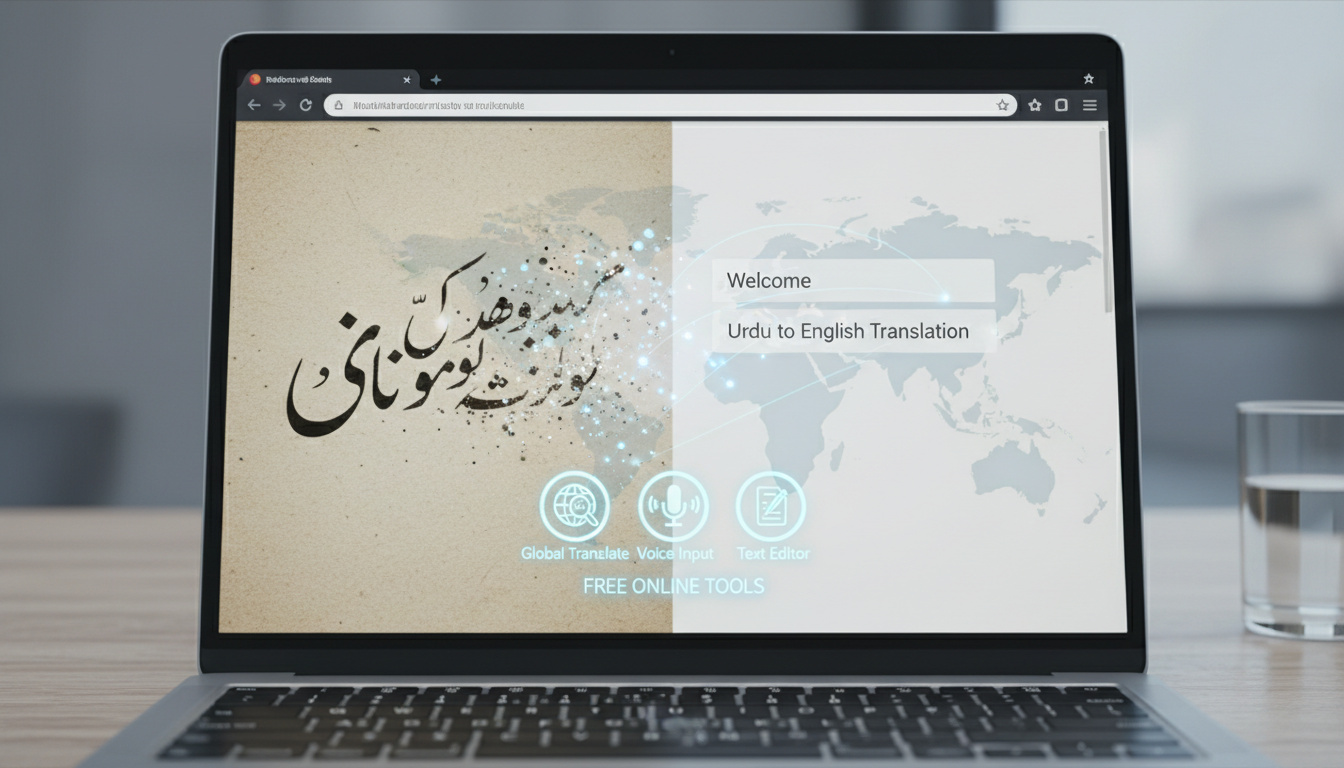
Bridging the linguistic divide between Urdu and English has become increasingly accessible through free online translation platforms. Millions of speakers across Pakistan, India, and the global diaspora rely on instant digital tools to convert text, documents, and spoken dialogue between these widely used languages. Modern artificial intelligence now powers context-aware translations that handle everything from casual greetings to complex business correspondence.
The demand for accurate Urdu to English translation continues to surge as digital communication transcends borders. Whether deciphering official documents, translating literary passages, or facilitating everyday conversations, users require tools that respect the nuances of Perso-Arabic script while delivering natural English syntax. Understanding the capabilities and limitations of these services ensures effective communication without costly errors.
Which Free Online Tools Deliver the Most Accurate Urdu to English Translation?
QuillBot, Wordvice AI, OnlineTranslationPro, Lingvanex, and Translate.com lead the market with instant AI-powered conversion capabilities.
Context-aware algorithms excel at sentence structure and grammar but vary in handling complex literary or idiomatic Urdu.
Text translation dominates free tiers, with document and voice features available through specialized apps and premium services.
Dedicated iOS and Android applications offer offline functionality, though web-based tools require internet connectivity.
- QuillBot processes up to 5,000 characters per translation without advertisements, supporting 52 languages with editing tools.
- Wordvice AI targets business and academic contexts through high-precision algorithms and specialized vocabulary handling.
- OnlineTranslationPro leverages Google APIs for rapid conversions, limiting requests to 500 characters but allowing unlimited submissions.
- Lingvanex operates without user registration or data storage, processing complex sentences with real-time privacy protection.
- Translate.com provides dictionary-based accuracy for individual words and short phrases rather than lengthy documents.
- AI systems achieve approximately 80-95% accuracy for simple, everyday text but struggle with poetic or highly nuanced content.
- All major platforms assume standard Unicode input rather than specialized Nastaliq script formatting.
| Specification | Detail |
|---|---|
| Global Urdu Speakers | 230 million+ |
| Writing System | Perso-Arabic (Nastaliq variant) |
| English Loanword Prevalence | High in modern usage |
| QuillBot Free Character Limit | 5,000 characters per translation |
| OnlineTranslationPro Request Cap | 500 characters per request |
| Lingvanex Data Retention | None (instant processing) |
| Supported Platforms | Web, iOS, Android, Windows, Mac |
| Voice Translation Availability | Via dedicated apps and Maestra.ai |
How Do Modern Translators Handle Voice, Documents, and Mobile Accessibility?
Beyond simple text conversion, contemporary translation ecosystems accommodate diverse input methods. Voice recognition technology now captures spoken Urdu and renders it into written English, while document processing tools preserve formatting across language barriers. These multimodal capabilities address real-world scenarios ranging from international business meetings to academic research.
Voice Translation and Audio Processing
Specialized platforms like Maestra.ai and Notta offer AI-driven conversion of Urdu audio into English text and subtitles, supporting over 125 languages with voice cloning capabilities. The Urdu English Translator mobile application provides offline phrasebooks and text scanning alongside voice translation features. These tools prove particularly valuable for travelers and professionals conducting cross-lingual interviews or meetings.
Document and Professional Formats
Wordvice AI specifically targets business and academic document translation, maintaining specialized vocabulary databases for professional contexts. However, bulk document processing remains limited across free tiers, with most services optimizing for shorter text segments. Users seeking to translate extensive reports or legal contracts must typically segment content manually or upgrade to premium offerings.
Lingvanex processes translations instantly without storing user data or requiring account registration, making it suitable for sensitive communications. Most web-based tools, however, transmit text to cloud servers for processing.
Mobile Ecosystem and Offline Functionality
QuillBot maintains mobile-optimized web interfaces, while Lingvanex offers downloadable applications for iOS, Android, Windows, and Mac systems. These native apps often provide offline capabilities essential for travelers lacking consistent internet access. The Google Play marketplace hosts specialized Urdu-English tools combining dictionary functions with optical character recognition for photographed text.
What Accuracy Limitations Should Users Understand?
While artificial intelligence has dramatically improved translation quality, significant constraints persist when converting between Urdu and English. The structural differences between these languages—particularly Urdu’s subject-object-verb syntax versus English’s subject-verb-object construction—create inherent algorithmic challenges. Users must recognize scenarios where machine translation risks miscommunication or cultural insensitivity.
Context and Nuance Challenges
Machine translators consistently struggle with Urdu poetry, idiomatic expressions, and dialectal variations. The tools excel at literal translations of everyday phrases—numbers, family relations, and shopping terminology—but often miss cultural subtext embedded in classical literature or regional slang. OnlineTranslationPro explicitly warns against using automated services for mission-critical legal or medical texts where precision proves paramount.
Character Restrictions and Usage Caps
Free tiers impose strict limitations that affect workflow efficiency. QuillBot caps individual translations at 5,000 characters, while OnlineTranslationPro restricts requests to 500 characters each. These boundaries necessitate breaking longer documents into segments, potentially disrupting contextual coherence across sections. Users requiring unlimited processing must subscribe to premium tiers or utilize multiple platforms sequentially.
Professional human translators remain essential for legal contracts, medical diagnoses, immigration documents, and certified official papers. Machine tools provide “near-perfect” results for casual use but lack the precision required for binding agreements or health-related communications.
Grammatical and Tonal Inconsistencies
Even advanced AI systems occasionally generate awkward phrasing or incorrect gender agreements when translating Urdu’s gendered grammar into English. The Lingvanex platform emphasizes real-time updates to address these issues, yet users should manually review outputs for tone appropriateness in professional correspondence. Complex sentences involving multiple clauses particularly challenge automated parsing systems.
When Is Professional Human Translation Necessary?
Certain contexts demand the cultural fluency and contextual judgment that only human linguists provide. Legal proceedings, medical consultations, literary publishing, and diplomatic communications require nuanced interpretation that considers historical context, regional dialects, and intended audience. Machine translation serves as a bridge for comprehension but cannot replace certified professionals for official documentation.
Human translators also navigate the Nastaliq script’s aesthetic complexities—traditional cursive Urdu calligraphy—whereas digital tools process only standardized Unicode characters. For creative works, marketing materials, or any content where emotional resonance matters, professional services ensure that subtle connotations survive the conversion process. The investment proves worthwhile when errors could result in financial liability or personal harm.
Current translation tools assume standard Unicode input for Urdu text. Nastaliq script, the traditional cursive font used in formal Urdu publications, requires specialized font rendering that automated platforms do not specifically address or optimize.
How Has Urdu-English Translation Technology Evolved?
-
Google Translate launches with basic statistical machine translation capabilities, initially supporting limited language pairs.
-
Urdu support expands across major platforms, integrating right-to-left text processing and Perso-Arabic character recognition.
-
Neural Machine Translation (NMT) replaces statistical models, dramatically improving fluency and grammatical accuracy.
-
Multimodal capabilities emerge, enabling voice-to-text, image translation, and real-time conversation features.
-
Advanced AI models incorporate context-aware processing, handling complex sentence structures and specialized terminology with improved precision.
What Aspects of Urdu Translation Are Reliable Versus Uncertain?
| Established Capabilities | Uncertain or Variable Areas |
|---|---|
| Literal word-for-word translations | Idiomatic expressions and proverbs |
| Common conversational phrases | Poetic and literary metaphors |
| Numbers, dates, and factual data | Regional dialect variations (Pakistani vs. Indian Urdu) |
| Standard Unicode text input | Nastaliq cursive script rendering |
| Technical and scientific terminology | Cultural context and social nuance |
| Simple sentence structures | Complex nested clauses and conditional statements |
What Cultural and Linguistic Context Shapes Urdu Translation?
Urdu functions as a pluricentric language with significant variations between Pakistani and Indian usage, though standardization efforts have minimized divergence in formal writing. The language incorporates substantial Persian and Arabic vocabulary alongside Sanskrit-derived roots, creating layered semantic fields that challenge direct English equivalents. Understanding whether a text employs high-register Persianized Urdu or colloquial Hindustani significantly impacts translation strategy.
The right-to-left writing system requires particular attention during digital conversion, as formatting errors frequently occur when mixing Urdu with English or numerals. Code-switching—alternating between Urdu and English within single sentences—represents common practice in South Asian digital communication, yet automated systems sometimes fail to recognize language boundaries accurately. This linguistic reality reflects the broader phenomenon of Feeling Sick After Eating – Causes and Remedies in diverse cultural contexts where multiple influences intersect.
Religious and cultural terminology presents additional complexity, as Urdu serves as the primary language for Islamic scholarship in South Asia while also carrying secular literary traditions. Translators must navigate honorifics, religious references, and social hierarchies encoded in pronoun choices and verb conjugations. These subtleties often disappear in automated conversion, potentially flattening the social or spiritual significance of original texts.
What Do Sources Indicate About Translation Quality and Standards?
“QuillBot provides up to 5,000 free characters per translation with context-aware AI designed for natural results across 52 languages.”
— QuillBot Translation Platform
“OnlineTranslationPro leverages Google APIs for near-perfect everyday translations, completing requests in seconds up to 1,000 words, though we recommend human translators for legal or medical precision.”
— OnlineTranslationPro Service Documentation
“Lingvanex delivers instant, context-sensitive translations with real-time updates and privacy protection, processing complex sentences without storing user data.”
— Lingvanex Technical Specifications
What Are the Essential Takeaways for Urdu Translation Users?
Free online tools provide immediate solutions for everyday Urdu to English translation needs, with platforms like QuillBot and Lingvanex offering robust character limits and privacy protections. Users should reserve these services for informal communication, basic comprehension, and short text conversion while engaging professional translators for legal, medical, or literary projects. Success depends on understanding platform limitations, respecting character caps, and manually reviewing outputs for tonal accuracy. For those seeking comfort in reliable daily tools, exploring options resembles finding the perfect fit in M&S Slippers – Expert Guide to Top Comfort Options—personal needs dictate the ideal choice.
Frequently Asked Questions
Is Google Translate accurate for Urdu to English conversion?
Google Translate provides functional accuracy for everyday phrases and simple sentences, achieving approximately 80-95% precision for common text. However, it struggles with complex grammar, idioms, and formal literary Urdu.
Can I translate Urdu PDF documents to English for free?
Wordvice AI supports document translation for business and academic files, though bulk processing typically requires premium subscriptions. Most free tools require copying and pasting text manually due to character limitations.
How do I type Urdu if my keyboard only has English letters?
Use virtual Urdu keyboards available through Google Input Tools or platform-specific text editors. Most translation websites include built-in Urdu keyboards. Alternatively, phonetic typing tools convert Roman Urdu (English letters) into proper Urdu script.
Are free translation tools safe for confidential business communications?
Lingvanex processes translations without data storage, making it suitable for sensitive content. However, most free platforms retain text temporarily on servers. Avoid entering trade secrets, personal identification numbers, or legally sensitive material into public translation tools.
Can I translate spoken Urdu conversations in real time?
Yes, mobile applications like the Urdu English Translator app and services such as Maestra.ai offer voice-to-text conversion. These tools work best with clear pronunciation and may struggle with heavy accents or background noise.
Why do translations of Urdu poetry often sound awkward?
Machine algorithms prioritize literal accuracy over poetic meter, metaphorical language, and cultural allusions. Urdu poetry relies heavily on classical Persian and Arabic references that lack direct English equivalents, requiring human artistic interpretation.
What is the difference between Pakistani and Indian Urdu in translation?
While mutually intelligible, Pakistani Urdu incorporates more Persian and Arabic vocabulary, while Indian Urdu blends closer with Hindi. Pronunciation and certain vocabulary choices differ, though standard written Urdu remains largely uniform across both regions.

Jack Thomas Clarke Thompson is a staff writer for PopCultureDaily.co.uk, covering entertainment news, film, television, streaming and celebrity culture. He works under Editor-in-Chief Harriet Winslow and Managing Editor Lucas Bennett, following the newsroom standards for sourcing, verification and fact-checking set out in our editorial policies.