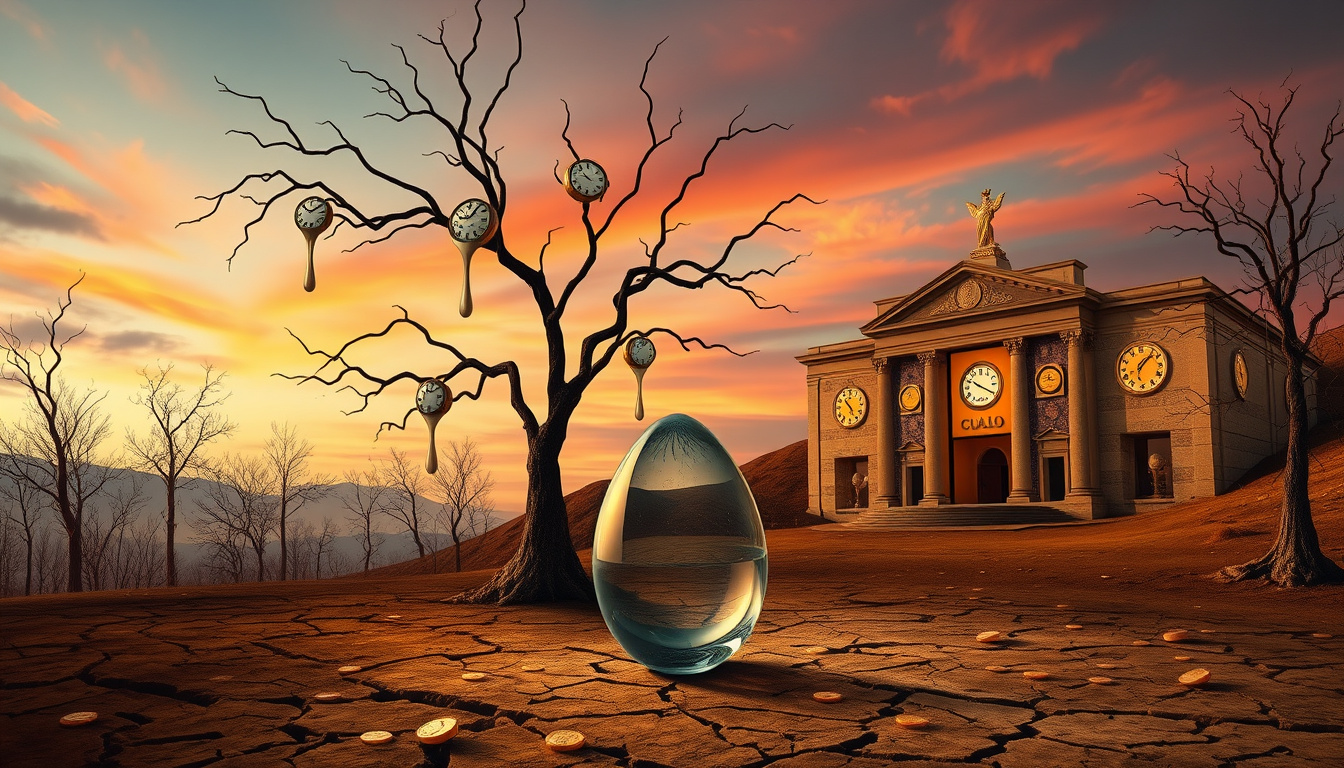
Salvador Dalí was a Spanish Surrealist artist, filmmaker, and writer born in Figueres, Catalonia, in 1904, and he became one of the most recognizable artists of the 20th century. He is best known for The Persistence of Memory (1931), his “melting clocks” painting, and for turning his own eccentric persona into part of his public legacy.
From his meticulously crafted dreamscapes to his flamboyant public appearances, Dalí redefined what it meant to be an artist. His work combined technical mastery with psychological depth, drawing on Freudian theory and his own invented “paranoiac-critical method.”
This article covers his life, his most iconic paintings, the museums that preserve his legacy, and the questions that still surround his personal beliefs and financial standing.
Who Was Salvador Dalí?
Dalí was born Salvador Domingo Felipe Jacinto Dalí i Domènech on May 11, 1904, in Figueres, Spain. The Dali Museum says his family background shaped his worldview: his mother was a devout Catholic and his father an atheist, and both supported his early talent.
He studied art in Figueres and later at the Real Academia de Bellas Artes de San Fernando in Madrid. In the late 1920s he moved toward Surrealism, joined the Surrealist group in 1929, and became one of its leading figures. For more on influential cultural figures, read about Charles Dickens – Biography, Books and Lasting Literary Legacy.
Surrealist Master
Spanish painter, 1904–1989
Most Famous Work
The Persistence of Memory
Major Museum
The Dalí Museum, St. Petersburg, FL
Estimated Net Worth
$10–$20 million (at death)
Key insights about Dalí’s life and work:
- Dalí’s technical skill rivaled Old Masters, but his subject matter broke all conventions.
- The melting clocks symbolize the relativity of time and space, influenced by Einstein.
- Dalí was deeply fascinated by religion, oscillating between atheism and Catholic mysticism.
- His net worth remains a topic of speculation; his estate still generates revenue via licensing.
- He met Gala in 1929, who became his muse and central partner in life and art.
- He lived in the United States from 1940 to 1948, achieving major commercial success.
- The Teatro-Museo Dalí opened in Figueres in 1974, which he helped create.
| Category | Detail |
|---|---|
| Born | May 11, 1904, Figueres, Spain |
| Died | January 23, 1989, Figueres, Spain |
| Movement | Surrealism, Cubism, Classicism |
| Known For | Surrealist imagery, meticulous technique |
| Spouse | Gala Dalí (m. 1934–1982) |
| Major Museum | Dalí Theatre-Museum (Spain), The Dalí Museum (USA) |
What Are Salvador Dalí’s Most Famous Paintings?
The Persistence of Memory (1931)
This is Dalí’s best-known painting, famous for its melting watches. The work explores the fluidity of time, a concept influenced by Einstein’s theory of relativity. It remains one of the most reproduced and recognized images in modern art.
The Great Masturbator (1929)
Described as one of his first major Surrealist works, this painting delves into themes of sexuality, guilt, and desire. It reflects his fascination with Freudian psychology and the subconscious mind.
Un Chien andalou (1929) and L’Âge d’or (1930)
These Surrealist films were made with filmmaker Luis Buñuel. Un Chien andalou is famous for its shocking opening scene and its dreamlike, non-linear narrative. Both films remain landmark works of avant-garde cinema.
Nuclear Mysticism Period
After returning to Spain in 1948, Dalí announced his return to the Catholic faith and developed a style he called nuclear mysticism. From about 1950 to 1970 he painted many works with religious themes, blending scientific imagery with traditional Catholic iconography.
Sources describe his use of the “paranoiac-critical method,” a technique he said let him access deeper truths through controlled hallucination and associative thinking. This method became central to his creative process.
Where Can You See Salvador Dalí’s Art?
Dalí’s museum legacy is centered on the Teatro-Museo Dalí in Figueres, which he helped create and which opened in 1974. The museum is located near his birthplace and is one of the main institutions preserving and presenting his work.
Another major institution is The Dalí Museum in St. Petersburg, Florida. It houses a vast collection of his works, including paintings, drawings, and sculptures, and regularly hosts exhibitions exploring different aspects of his career.
Both museums can be busy during peak tourist seasons. Advance ticket booking is recommended, especially for The Dalí Museum in Florida, which attracts visitors from around the world.
Salvador Dalí: A Timeline of His Life
- 1904 – Born in Figueres, Spain.
- 1922 – Enters the Real Academia de Bellas Artes de San Fernando in Madrid.
- 1929 – Joins the Surrealist movement; meets Gala, who becomes his lifelong muse.
- 1931 – Paints The Persistence of Memory, his most famous work.
- 1940–1948 – Exile in the United States during World War II; achieves major commercial success.
- 1948 – Returns to Spain and announces his return to the Catholic faith.
- 1960s – Begins creating the Dalí Theatre-Museum in Figueres.
- 1974 – The Teatro-Museo Dalí opens to the public.
- 1982 – Gala Dalí dies.
- 1989 – Salvador Dalí dies in Figueres at the age of 84.
What Is Known and What Remains Uncertain About Dalí?
Some myths persist around Dalí’s eccentric behavior, such as stories about him carrying an anteater. While his public persona was carefully cultivated, his artistic contributions are well-documented. His religious views, however, were complex and changed significantly over time.
Established Information
- He was a leading figure in Surrealism.
- The Persistence of Memory is his most famous painting.
- He used the “paranoiac-critical method” to generate ideas.
- He returned to the Catholic faith in 1948.
Information That Remains Unclear
- The exact value of his personal net worth at the time of his death.
- The full extent of his collaboration with commercial brands.
- Whether some of his most outrageous public stunts were genuine or purely performative.
Dalí’s Place in Art History and Pop Culture
Dalí’s legacy is that he became the best-known Surrealist artist, famous not only for his paintings but also for his films, public persona, and long-term influence on modern art and popular culture. His work helped define the visual language of Surrealism, and his later religious and scientific paintings showed how he kept reinventing himself beyond the movement that made him famous.
His influence can be seen in everything from fashion and advertising to film and digital art. The interplay between his Catalan identity, his fascination with science, and his theatrical self-promotion created a blueprint for the modern artist-celebrity.
Quotes and Sources
“A true artist is not one who is inspired, but one who inspires others.”
Salvador Dalí, Diary of a Genius
“What is important is to spread confusion, not eliminate it.”
Salvador Dalí
What Comes Next for Dalí’s Legacy?
Ongoing estate management, major exhibitions at The Dalí Museum (2024–2025), and continued auction interest in his works keep his name in the public eye. Expect more AI-focused art analysis referencing Dalí’s dream logic, as artists and technologists continue to explore the boundaries of creativity he pushed. For more on influential cultural figures, read about Donatella Versace – Age, net worth and transformation.
Frequently Asked Questions
What is the meaning of the melting clocks in Dalí’s painting?
The melting clocks symbolize the fluidity and relativity of time, inspired by Einstein’s theory of relativity.
How much is a Salvador Dalí painting worth?
Prices vary widely from $10,000 for prints to over $20 million for original works like Portrait of Paul Éluard.
Was Salvador Dalí religious?
Dalí had a complex relationship with religion; he was raised Catholic, rejected it in youth, but later returned to faith, creating many religious-themed works.
Where is the best place to see Dalí’s work?
The two major museums are the Dalí Theatre-Museum in Figueres, Spain, and The Dalí Museum in St. Petersburg, Florida.
What is the “paranoiac-critical method”?
It was a technique Dalí developed to access the subconscious through controlled hallucinations and associative thinking, helping him generate surreal imagery.
Did Dalí work in film?
Yes, he co-created two landmark Surrealist films with Luis Buñuel: Un Chien andalou (1929) and L’Âge d’or (1930).
Who was Gala Dalí?
Gala was Dalí’s wife, muse, and business manager. They met in 1929 and remained together until her death in 1982.
How old was Dalí when he died?
Salvador Dalí died on January 23, 1989, in Figueres, Spain, at the age of 84.
What is nuclear mysticism?
It was a style Dalí developed after his return to Catholicism in 1948, blending scientific imagery with religious themes.

Jack Thomas Clarke Thompson is a staff writer for PopCultureDaily.co.uk, covering entertainment news, film, television, streaming and celebrity culture. He works under Editor-in-Chief Harriet Winslow and Managing Editor Lucas Bennett, following the newsroom standards for sourcing, verification and fact-checking set out in our editorial policies.