
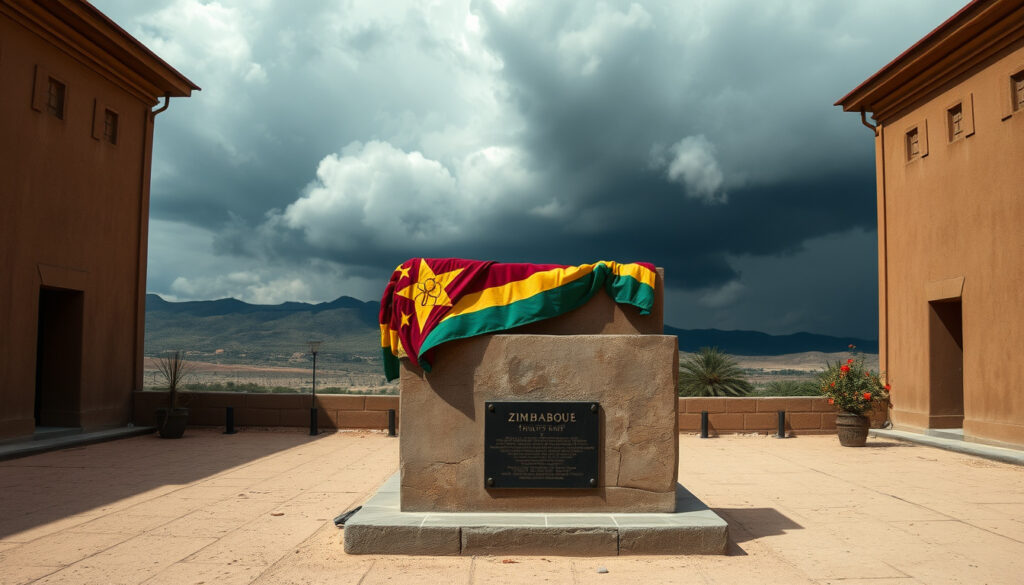
Robert Gabriel Mugabe was Zimbabwe’s liberation-era leader, first prime minister after independence in 1980, and later president from 1987 until he was forced out in 2017; he died in Singapore on 6 September 2019 at age 95. His life and rule are widely remembered as a mix of anti-colonial liberation, authoritarian governance, economic collapse, and a deeply contested land reform program.
Born on 21 February 1924 in Kutama, Southern Rhodesia (now Zimbabwe), Mugabe became a central figure in the nation’s fight against white-minority rule. After leading the country for 37 years, he was forced out in a military intervention in November 2017. His legacy remains sharply divided.
Who Was Robert Mugabe? A Full Biography
Robert Mugabe: Zimbabwe’s Founding Father and Controversial Strongman.
| Born | 21 February 1924, Zvimba, Southern Rhodesia |
| Died | 6 September 2019, Singapore (age 95) |
| Role | First Prime Minister (1980–1987), President (1987–2017) |
| Known For | Independence leader, land reform program, disputed legacy |
- Mugabe remains one of the most polarizing African leaders — celebrated as a liberation hero and condemned as a dictator.
- His educational background (multiple degrees, teaching career) set him apart from many contemporaries.
- The Fast Track Land Reform Programme remains the single most debated aspect of his legacy.
- Mugabe’s death in 2019 did not end his family’s public visibility; sons Robert Jr and Chatunga frequently appear in news.
- Mugabe was imprisoned for 11 years for his political activities before assuming power.
- His first wife, Sally Hayfron, was a prominent political figure in her own right.
- The 2008 contested election led to a violent power-sharing agreement with opposition leader Morgan Tsvangirai.
| Category | Fact |
|---|---|
| Full Name | Robert Gabriel Mugabe |
| Birthdate | 21 February 1924 |
| Death Date | 6 September 2019 |
| Education | University of Fort Hare, University of London (degrees in history, law, education) |
| Spouse | Sally Hayfron (m. 1961, died 1992), Grace Marufu (m. 1996) |
| Children | Nhamodzenyika Mugabe (deceased), Bona Mugabe, Robert Mugabe Jr, Chatunga Bellarmine Mugabe |
| Notable Event | Fast Track Land Reform Programme (FTLRP), 2000 onwards |
| Overthrow | Deposed via military intervention, November 2017 |
| Successor | Emmerson Mnangagwa |
| Net Worth at Death | Disputed (estimates range from $1M to $15M; no official probate confirmed) |
When and How Did Robert Mugabe Die?
What Did Robert Mugabe Die Of?
Mugabe died at age 95 in Singapore on 6 September 2019. Official reports stated he suffered from cancer and heart issues. No detailed autopsy findings were released to the public.
Where Is Robert Mugabe Buried?
After a period of dispute over whether he would be interred at a national monument, Mugabe was buried in his home village of Zvimba, in a courtyard at his rural home.
Robert Mugabe Funeral Details
His funeral was held at the National Sports Stadium in Harare, with regional leaders attending. Burial at Heroes’ Acre in Harare was blocked by the government of President Emmerson Mnangagwa, leading to a months-long standoff with the family. Al Jazeera reported that the military had taken control days after the funeral arrangements were announced.
While Mugabe died in Singapore at age 95, the specific nature of his terminal illness was not fully disclosed in official records or by his family.
Robert Mugabe’s Family: Children, Net Worth, and Descendants
How Many Children Did Robert Mugabe Have?
Mugabe had five known children. With his first wife Sally Hayfron, he had a son, Nhamodzenyika, who died in childhood. With his second wife Grace Mugabe, he had three children: Bona Mugabe-Chikore (born 1989), Robert Peter Mugabe Jr. (born 1992), and Chatunga Bellarmine Mugabe (born 1998). Reports suggest other children may exist, but these are unconfirmed.
Who Is Robert Mugabe Jr.?
Robert Mugabe Jr. is a businessman and public figure who has occasionally made headlines in Zimbabwe. He is the eldest son of Grace Mugabe.
What Is Chatunga Bellarmine Mugabe Known For?
Chatunga Bellarmine Mugabe is the younger son of Grace and Robert Mugabe. He has been in the news for his lifestyle and social media activity, which sometimes draws comparisons to his father’s austere public image. The Guardian has tracked the family’s public visibility following Mugabe’s death.
No reliable figure for Mugabe’s net worth exists in standard biographical references such as Wikipedia, Britannica, or BBC profiles. Estimates vary, but no official probate has confirmed any specific sum.
Robert Mugabe Legacy: Hero or Tyrant?
What Was Mugabe’s Role in Zimbabwe’s Independence?
Mugabe was a key leader in the liberation struggle against white-minority rule. He co-founded the Zimbabwe African National Union (ZANU) and led it to independence in 1980, becoming the country’s first prime minister. Britannica notes that he later came under pressure to step down amid concerns about a succession plan involving his wife.
What Was the Fast Track Land Reform Programme?
The FTLRP, launched in 2000, aimed to redistribute land from white commercial farmers to Black Zimbabweans. Sources describe it as a policy that caused major economic disruption, poverty, and international condemnation. The BBC characterizes it as “catastrophic.”
How Did Mugabe Lose Power?
In November 2017, the military took control, placing Mugabe under house arrest, and parliament moved toward impeachment. He resigned on 21 November 2017, ending 37 years in power. The takeover is often described as an internal coup. Africa Confidential provides specialist political context on the internal dynamics of ZANU–PF that led to his ouster.
Assessments of Mugabe’s legacy depend heavily on perspective. The BBC describes him as moving “from liberator to tyrant.” Britannica frames him as both a nationalist icon and an authoritarian ruler.
What Were the Key Events in Robert Mugabe’s Life?
- 1924: Born in Zvimba, Southern Rhodesia. (Wikipedia)
- 1963: Arrested for political activism; imprisoned 11 years. (Britannica)
- 1980: Wins independence election; becomes Prime Minister. (BBC News)
- 1987: Becomes President; alters constitution. (Britannica)
- 2000: Launches Fast Track Land Reform Programme. (BBC News)
- 2017: Ousted in military intervention; resigns 21 November. (Al Jazeera)
- 6 September 2019: Dies in Singapore. (BBC News)
- 2019–2020: Funeral, burial disputes in Zvimba. (The Guardian)
What Is Known and What Remains Unclear About Robert Mugabe?
| Established Information | Information That Remains Unclear |
|---|---|
| Mugabe was born on 21 February 1924 and died on 6 September 2019. | The exact cause of death was not fully disclosed. |
| He was the first prime minister and later president of Zimbabwe. | His net worth at death is unverified and heavily disputed. |
| He was married and had publicly known children. | Unconfirmed reports of additional children exist. |
| He was ousted in a military intervention in 2017. | The precise financial arrangements surrounding his resignation are unknown. |
What Is the Historical Context of Mugabe’s Rule?
Mugabe’s political evolution from revolutionary to authoritarian is best understood through Zimbabwe’s colonial history and the liberation struggle. Rhodesia was a British colony governed by a white minority that declared unilateral independence in 1965, leading to a protracted bush war. Mugabe’s ZANU party was one of the primary factions fighting against this regime.
The FTLRP is widely considered both an economic disaster and a necessary historical correction, depending on the viewpoint. Mugabe’s international image shifted dramatically from African liberation icon to pariah, especially after 2000, when the land seizures began in earnest and the economy started its steep decline.
His family’s posthumous prominence raises questions about wealth preservation and the management of his legacy in modern Zimbabwe. The scrutiny faced by the Mugabe family reflects a broader public interest in the personal lives of controversial leaders, similar to the coverage of Salman Rushdie – Life, Books, and the Fatwa Controversy.
How Do Major Sources Describe Robert Mugabe?
“From liberator to tyrant.”
— BBC News obituary
Major biographical resources do not contain a vetted collection of direct Mugabe quotations. His own words are most reliably found in verified transcripts of his UN addresses or state media broadcasts. The framing most commonly applied by analysts is the “liberator to tyrant” narrative, as summarized by the BBC and reflected in Britannica’s dual characterization of him as a nationalist icon and an authoritarian ruler.
How Should Robert Mugabe Be Remembered?
Robert Mugabe’s legacy is irreconcilably split. To some, he remains the liberator who freed Zimbabwe from colonialism and expanded educational access in the early years after 1980. To others, he is the authoritarian who dismantled the economy through land reform and suppressed dissent. This duality places him in a category of leaders whose historical judgment remains contested, analyzed through modern political accountability in Matt Hancock – Biography, Scandal, and Status in 2025.
What Are the Most Frequently Asked Questions About Robert Mugabe?
What was Robert Mugabe’s education level?
Mugabe earned multiple degrees including a B.A. from the University of Fort Hare, a B.Ed., a B.Sc. (Economics), and an LL.B. (Law) via correspondence from the University of London. He was a teacher before politics.
Did Robert Mugabe write an autobiography?
No formal autobiography was published by Mugabe. Several third-party biographies exist.
What does ‘RG Mugabe’ stand for?
Robert Gabriel Mugabe. The initials ‘RG’ are sometimes used as shorthand in political contexts.
Are Chatunga Bellarmine Mugabe and Robert Mugabe Jr the same person?
No. Robert Mugabe Jr is the eldest son (born 1992). Chatunga Bellarmine Mugabe is a younger brother (born 1998). Both are children of Grace Mugabe.
How long was Robert Mugabe in power?
He served as Prime Minister from 1980 to 1987 and as President from 1987 to 2017, totaling 37 years in power.
Who succeeded Robert Mugabe as president?
Emmerson Mnangagwa, his former vice president, succeeded him after the 2017 military intervention.
What was the military operation that removed Mugabe?
The operation was often referred to as Operation Restore Legacy. It was an internal military intervention that placed Mugabe under house arrest and led to his resignation.
Where was Robert Mugabe born?
He was born on 21 February 1924 in Kutama, Zvimba, Southern Rhodesia (now Zimbabwe).
How many children did Robert Mugabe have?
Mugabe had five known children: one son with his first wife Sally Hayfron, and three children with his second wife Grace Mugabe. Other children are sometimes rumored but remain unconfirmed.

Jack Thomas Clarke Thompson is a staff writer for PopCultureDaily.co.uk, covering entertainment news, film, television, streaming and celebrity culture. He works under Editor-in-Chief Harriet Winslow and Managing Editor Lucas Bennett, following the newsroom standards for sourcing, verification and fact-checking set out in our editorial policies.