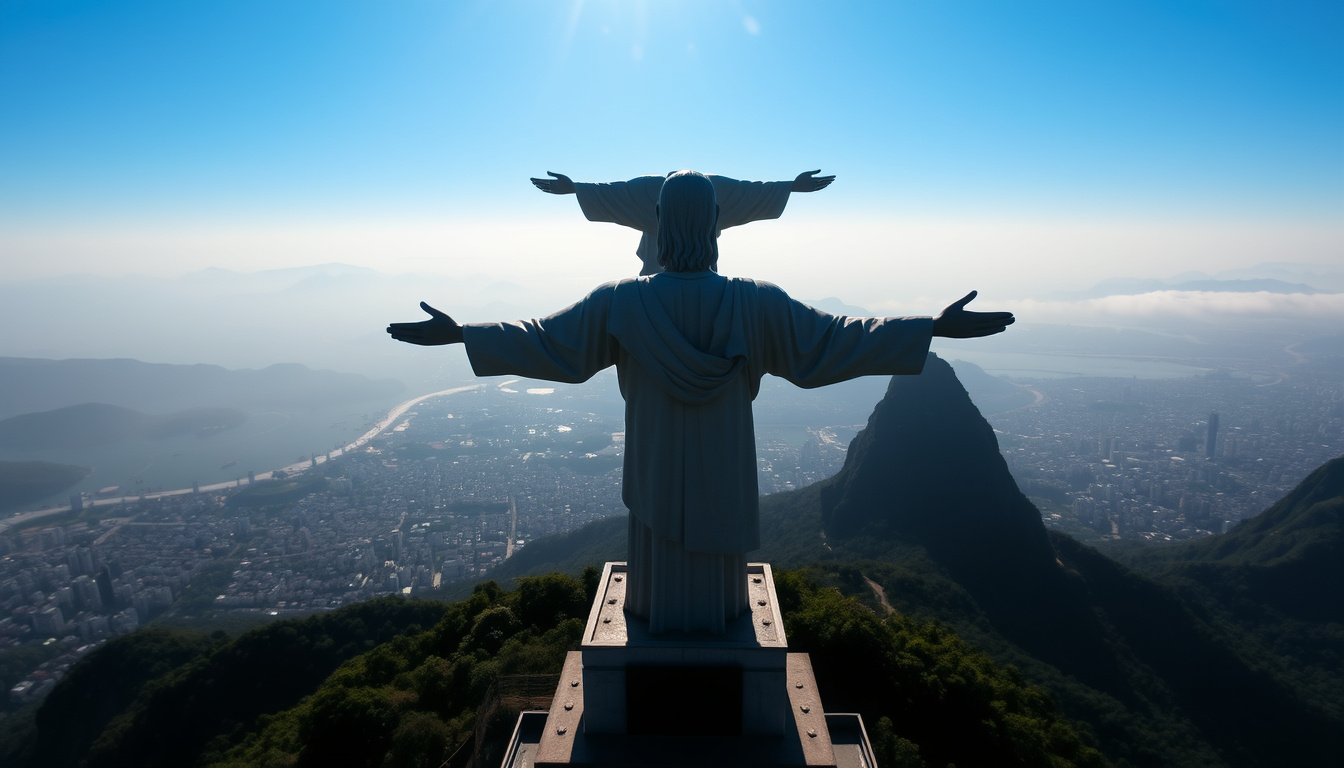

Perched 700 meters above Rio de Janeiro on the summit of Mount Corcovado, Christ the Redeemer stands as one of the most recognized landmarks on the planet. The 30-meter Art Deco statue of Jesus Christ, arms stretched 28 meters wide, has watched over the city since its inauguration in 1931. But beyond its striking silhouette lies a story rooted in religious devotion, engineering ingenuity, and a response to early 20th-century anxieties about secularism.
The monument was conceived during a period when Catholic groups in Brazil grew concerned about what they perceived as rising godlessness in society. What began as a modest proposal in the 1850s by a Catholic priest eventually became a national project that took nearly a decade to complete. Today, the statue is not only a symbol of faith but also a cultural and economic engine for Rio de Janeiro, drawing millions of visitors each year.
The statue’s prominence extends beyond religion. In 2007, it was voted one of the New 7 Wonders of the World, cementing its place in global culture. Its location within the Tijuca National Park, a UNESCO Biosphere Reserve, adds an environmental dimension to its significance. This article explores the history, dimensions, visitor information, and recent developments surrounding this iconic structure.
Why Was Christ the Redeemer Built?
The idea for a Christian monument on Mount Corcovado first emerged in the 1850s, when Catholic priest Pedro Maria Boss proposed the concept and sought funding from Princess Isabel. The project was abandoned after Brazil became a republic in 1889, which formally separated church and state. The proposal was revived in 1920 by Catholic organizations worried about the spread of atheism in Rio de Janeiro. The project received official approval in 1922, timed to coincide with the 100th anniversary of Brazilian independence.
30 meters (98 ft) plus 8m pedestal
Corcovado Mountain, Rio de Janeiro, Brazil
October 12, 1931
One of the New7Wonders of the World
Key insights about the statue’s origin and construction:
- It was built as a response to perceived “godlessness” following World War I and rising secularism in Brazil.
- Construction took nine years, from 1922 to 1931, using reinforced concrete and soapstone.
- The statue was designed by French sculptor Paul Landowski and engineered by Brazilian Heitor da Silva Costa, with French engineer Albert Caquot. The face was sculpted by Romanian artist Gheorghe Leonida.
- It has been struck by lightning multiple times, notably in 2008, 2014, and 2021, each time requiring restoration.
- The statue sits within Tijuca National Park, a UNESCO Biosphere Reserve, making it part of an urban rainforest ecosystem.
- It is the largest Art Deco-style sculpture in the world.
- Approximately 2 million people visited the statue annually before the pandemic.
| Attribute | Value |
|---|---|
| Height (statue) | 30 meters (98 ft) |
| Height (pedestal included) | 38 meters (125 ft) |
| Width (arm span) | 28 meters (92 ft) |
| Weight | 635 tonnes (700 tons) |
| Material | Reinforced concrete, soapstone tiles |
| Sculptor | Paul Landowski (Polish-French) |
| Construction | 1922–1931 |
| Cost | ~$250,000 (1931 USD) |
| Annual visitors | ~2 million (pre-pandemic) |
How Tall Is Christ the Redeemer? (Facts & Dimensions)
The statue of Christ the Redeemer stands 30 meters (98 feet) tall, with its arms spanning 28 meters (92 feet) from fingertip to fingertip. When including the 8-meter pedestal, the total height reaches 38 meters (125 feet). The monument weighs 635 metric tons and is constructed from reinforced concrete, covered in thousands of triangular soapstone tiles chosen for their durability and resistance to weathering.
Materials and Engineering
The choice of reinforced concrete and soapstone was deliberate. Soapstone, a relatively soft metamorphic rock, was selected because it could withstand Rio’s humid subtropical climate and frequent storms. The statue’s internal structure is reinforced concrete, a material that allowed the builders to achieve the necessary strength while accommodating the Art Deco design. The project was an engineering challenge for its time, given the need to transport materials up the steep slopes of Mount Corcovado.
Comparison to Other Statues
Despite its monumental size, Christ the Redeemer is not the largest statue of Jesus in the world. Larger examples include Christ the King in Poland and the Cristo del Otero in Spain. However, it remains the largest Art Deco-style sculpture globally and is arguably the most recognizable, largely due to its dramatic mountaintop setting and its status as a New7Wonders of the World honoree.
The 30-meter measurement refers to the statue alone. The official total height of 38 meters includes the pedestal, which is why different sources may cite slightly different figures. Both measurements are correct depending on whether the pedestal is included.
How to Get Tickets for Christ the Redeemer Brazil
Visitors can reach Christ the Redeemer via the Corcovado train, which departs from the base station and offers a scenic ride through the Tijuca forest, or by tour buses that climb directly to the summit. The statue is open most of the day, and entrance tickets are described as inexpensive, though specific prices vary by season and booking method.
Best Time to Visit
Early morning and late afternoon are generally recommended to avoid the largest crowds and the midday heat. These times also provide the best lighting for photography, with the sun positioned to illuminate the statue and the panoramic views of Rio de Janeiro. Visitors should check the weather forecast before heading up, as clouds and fog can occasionally obscure the view from the summit.
Access and Transportation
The Corcovado train is the most popular way to reach the statue, running every 30 minutes on most days. Alternatively, private tour companies operate vans and buses that go directly to the entrance. For those looking to combine the visit with other landmarks, many guided tours include Christ the Redeemer alongside stops at Sugarloaf Mountain and Copacabana Beach.
Christ the Redeemer in 2021: What Happened?
In 2021, a powerful lightning strike hit Christ the Redeemer during a severe storm, causing damage to the statue’s head and thumb. The incident prompted a significant restoration effort. As part of the response, authorities quadrupled the crown of lightning rods near the statue’s head to provide better protection against the frequent electrical storms that affect the region.
The 2021 lightning strike was confirmed by Rio de Janeiro authorities and covered by Reuters and other news outlets. Damage primarily affected the thumb and head area. The restoration work included repairing the soapstone tiles and upgrading the lightning protection system.
Lightning strikes are not new to the statue. It was also hit in 2008 and 2014, with each event causing varying degrees of damage that required skilled restoration teams to repair the soapstone surface. The 2021 upgrade to the lightning rod system was intended to reduce future damage, though the statue’s exposed mountaintop position makes it inherently vulnerable to storms.
The restoration work in 2021 was part of ongoing maintenance efforts. The statue is regularly inspected and repaired, with a dedicated team responsible for preserving the soapstone tiles and concrete structure. The quadrupling of lightning rods was a significant upgrade to the protection system.
Where Can I Find Photos of Christ the Redeemer?
High-quality images of Christ the Redeemer are widely available through stock photography platforms, official tourism websites for Rio de Janeiro, and the statue’s own promotional materials. Many visitors also share their own photos on social media and travel blogs. For those seeking professional-grade images, resources like the Britannica entry on Christ the Redeemer and the New7Wonders official page feature curated images of the landmark from multiple angles.
The statue is one of the most photographed landmarks in the world, and its image appears in countless travel guides, documentaries, and films. Its distinctive silhouette against the backdrop of Rio’s coastline and the Sugarloaf Mountain makes it a favorite subject for photographers. Virtual tours are also available through some travel websites, offering 360-degree views of the site.
When Did Key Events in Christ the Redeemer’s History Occur?
The history of Christ the Redeemer spans more than 160 years, from the first proposal to recent restoration work. The following timeline outlines the most significant milestones, based on documented records from historical sources and news reports.
- 1859: Catholic priest Pedro Maria Boss suggests building a religious monument on Mount Corcovado and requests funding from Princess Isabel. The proposal is abandoned after Brazil becomes a republic in 1889.
- 1922: The 100th anniversary of Brazilian independence provides the impetus for a revived project. Catholic groups concerned about atheism push for the statue, and official approval is granted.
- 1926: The foundation stone is laid on the summit of Corcovado, marking the beginning of physical construction.
- 1931: October 12 – the statue is officially unveiled and inaugurated in a ceremony attended by dignitaries and thousands of onlookers.
- 2007: Christ the Redeemer is voted one of the New 7 Wonders of the World in a global poll, significantly boosting its international recognition.
- 2014: A lightning strike damages the statue’s thumb, requiring repairs to the soapstone surface.
- 2021: Another lightning strike during a storm damages the head and thumb. Authorities respond by quadrupling the lightning rod system around the statue’s head.
What Is Confirmed and What Remains Uncertain About Christ the Redeemer?
While most facts about Christ the Redeemer are well documented, some details are less clear or subject to common misconceptions. The table below separates what is established from what remains unconfirmed or uncertain.
| Established information | Information that remains unclear |
|---|---|
| The 2021 lightning strike damaged the thumb and head. Confirmed by Rio authorities and Reuters. | Rumors of a hidden chamber inside the statue persist, but no official chamber exists – only a small maintenance ladder inside. |
| The statue is 30 meters tall (98 ft), plus an 8-meter pedestal, totaling 38 meters (125 ft). | Some sources round the height differently, leading to slight discrepancies in published figures. |
| Christ the Redeemer is made of reinforced concrete and soapstone, not marble or iron. | The exact number of soapstone tiles is not consistently documented across sources. |
| It is the largest Art Deco sculpture in the world. | It is not the largest statue of Jesus – several larger ones exist elsewhere, such as Christ the King in Poland. |
What Is the Broader Significance of Christ the Redeemer?
Christ the Redeemer holds deep religious and cultural meaning for Brazil and the world. For many, it is a symbol of Christianity and a representation of peace and welcome. The statue’s open-armed posture is widely interpreted as an invitation, and it has become an enduring emblem of Rio de Janeiro itself. Its image appears in films, music videos, and advertisements, reinforcing its status as a global cultural icon.
From an engineering perspective, the statue was a remarkable achievement for its time. Building a 635-ton reinforced concrete and soapstone structure on a mountaintop in the 1920s, with limited technology, required significant innovation. The project brought together talent from France, Brazil, and Romania, reflecting the international collaboration required to realize such an ambitious vision. For a look at another globally recognized cultural icon, see Winnie The Pooh – History, Movies, Quotes and Public Domain.
Environmentally, the statue sits within Tijuca National Park, which is recognized as a UNESCO Biosphere Reserve. This urban rainforest is one of the largest of its kind, providing habitat for native species and offering visitors a unique combination of cultural heritage and natural beauty.
What Do Official Sources Say About Christ the Redeemer?
Several authoritative sources provide verified information about the statue. Wikipedia details the construction timeline, design specifications, and cultural impact, with citations to books, government archives, and news reports. Britannica offers a concise overview of the statue’s history, height, and significance, drawing on its editorial standards. The New7Wonders foundation confirms the statue’s status as one of the seven modern wonders. Local news coverage of the 2021 lightning strike and restoration, including reports from Reuters, provides firsthand documentation of recent events.
“This statue is not just a work of art. It is a symbol of faith.” – Paul Landowski, sculptor of Christ the Redeemer (paraphrased from interviews).
HistoryHit provides additional context on the statue’s origins and visitor access, while EBSCO’s research starter offers a summary of key facts suitable for academic reference. These sources collectively paint a consistent picture of the statue’s dimensions, history, and cultural role.
What Should You Remember About Christ the Redeemer?
Christ the Redeemer is a 30-meter Art Deco statue atop Mount Corcovado in Rio de Janeiro, completed in 1931 as a symbol of faith and a response to rising secularism. It is made of reinforced concrete and soapstone, weighs 635 tons, and was voted one of the New 7 Wonders of the World in 2007. Visitors can reach it via the Corcovado train or tour buses, with tickets available at modest prices. The statue has endured multiple lightning strikes, including a significant event in 2021 that led to an upgraded protection system. Its location within Tijuca National Park adds environmental significance. For those interested in the intersection of art, engineering, and cultural symbolism, this monument remains one of the world’s most compelling landmarks. For a look at another globally recognized cultural icon, see Winnie The Pooh – History, Movies, Quotes and Public Domain.
Frequently Asked Questions About Christ the Redeemer
What is Christ the Redeemer made of?
The statue is made of reinforced concrete and covered in thousands of triangular soapstone tiles.
Who built Christ the Redeemer?
The statue was designed by French-Polish sculptor Paul Landowski, with Brazilian engineer Heitor da Silva Costa and Romanian sculptor Gheorghe Leonida creating the face.
How old is Christ the Redeemer?
Inaugurated in 1931, it is over 90 years old.
Is Christ the Redeemer a UNESCO World Heritage site?
Not directly, but it is located within Tijuca National Park, which is a UNESCO Biosphere Reserve.
How many tourists visit Christ the Redeemer each year?
Approximately 2 million visitors annually (pre-pandemic numbers).
What is the best time of day to visit Christ the Redeemer?
Early morning or late afternoon to avoid crowds and heat; also ideal for photos.
Does Christ the Redeemer have a hidden chamber?
There is no official chamber inside the statue. Only a small maintenance ladder provides interior access.
How much does it cost to visit Christ the Redeemer?
Entrance tickets are described as inexpensive, with specific prices varying by season and booking method.
What is the arm span of Christ the Redeemer?
The statue’s arms span 28 meters (92 feet) from fingertip to fingertip.
Was Christ the Redeemer struck by lightning in 2021?
Yes, confirmed by Rio de Janeiro authorities. The strike damaged the thumb and head, leading to restoration and upgraded lightning protection.

Jack Thomas Clarke Thompson is a staff writer for PopCultureDaily.co.uk, covering entertainment news, film, television, streaming and celebrity culture. He works under Editor-in-Chief Harriet Winslow and Managing Editor Lucas Bennett, following the newsroom standards for sourcing, verification and fact-checking set out in our editorial policies.