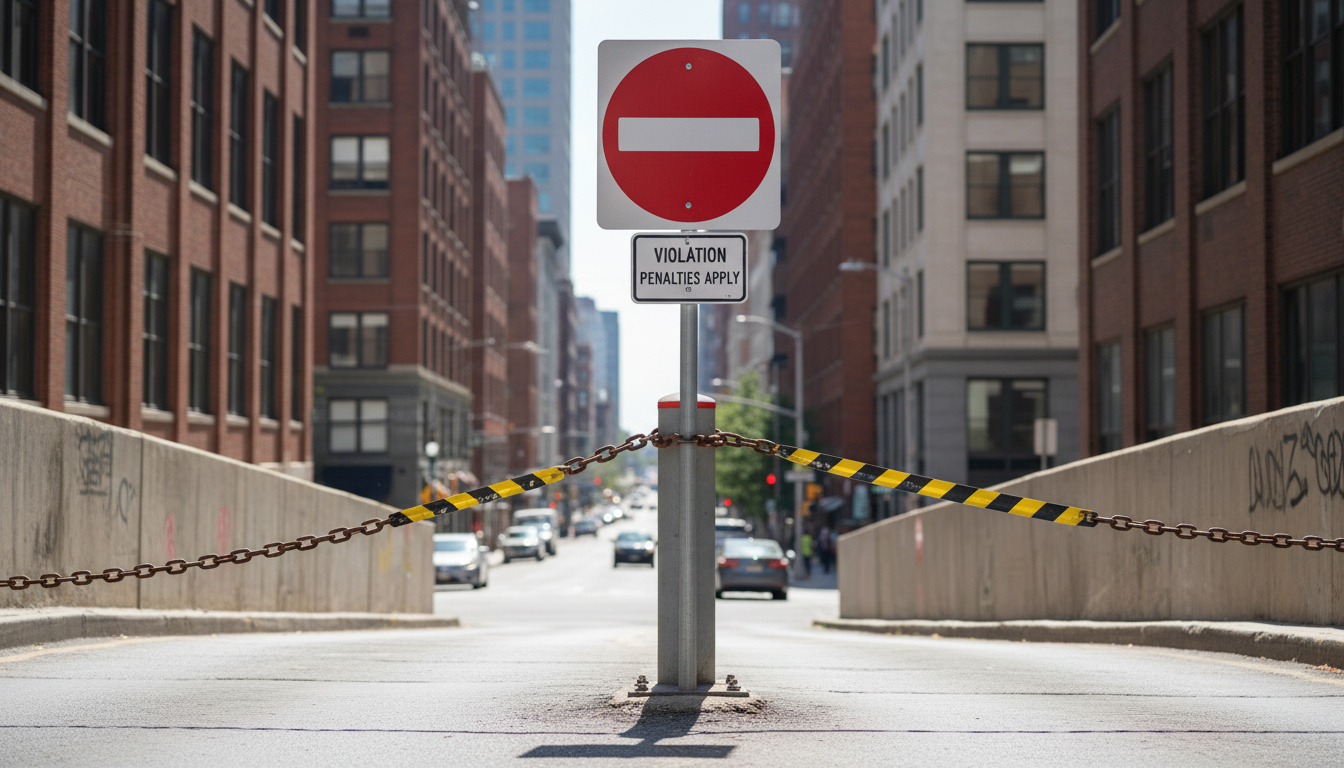
The “Do Not Enter” road sign stands as one of the most critical regulatory markers on modern roadways. Federal standards define this sign as an absolute prohibition against entering restricted roadways, including one-way streets, divided highways, and exit ramps. Its distinctive red circular design with a white horizontal bar creates immediate visual recognition for drivers approaching potentially dangerous wrong-way entry points.
Standardized under the Manual on Uniform Traffic Control Devices (MUTCD), this sign prevents head-on collisions and wrong-way driving incidents. Safety documentation confirms that the sign applies primarily to vehicular traffic, mandating that drivers halt and reverse rather than proceed into restricted zones.
What Does a No Entry Road Sign Mean?
The fundamental purpose remains absolute prohibition. Unlike warning signs that suggest caution, the no entry sign creates a legal barrier against advancement. Traffic control guidelines specify that entry constitutes a violation regardless of whether the road appears clear.
- The circular shape distinguishes it from rectangular regulatory signs and octagonal stop signs
- Red coloration signals universal prohibition across international standards
- MUTCD R5-1 designation governs federal and state highway usage in the United States
- UNECE Vienna Convention standardizes the design for over 80 countries internationally
- Reflective materials ensure visibility during both daylight and nighttime conditions
- The sign often pairs with “WRONG WAY” markers for drivers who proceed incorrectly
| Attribute | Details |
|---|---|
| Shape | Circular |
| Color | Red background, white bar |
| Standard | MUTCD/UNECE |
| Applies to | Vehicles primarily |
| Sign Code | R5-1 (US) |
| Category | Regulatory/Prohibitory |
| Installation | Right-side mounted facing wrong-way traffic |
| Reflectivity | Engineer grade or high intensity |
Where Are No Entry Road Signs Typically Used?
Placement follows specific traffic engineering protocols designed to intercept wrong-way movement before it enters dangerous corridors. MUTCD specifications require mounting on the right side of roadways facing potential wrong-way traffic at entry points.
One-Way Streets and Divided Highways
Installation occurs at the terminus of one-way roadways and exit ramps where drivers might mistakenly turn against designated flow. Divided highways utilize these signs at crossover points and emergency access routes to prevent catastrophic head-on collisions.
Security Areas and Restricted Zones
Military installations, private security gates, and restricted government facilities employ the same standardized design to signal absolute exclusion. Placement guidelines emphasize supplementary pavement markings to reinforce the visual barrier.
MUTCD mandates right-side mounting facing wrong-way traffic. Optional left-side installation applies only at intersecting roads, provided the sign is shielded or turned away from correct-direction traffic to avoid confusion.
Pedestrians and Non-Vehicular Traffic
Separate pedestrian signage utilizes different symbols and shapes, though walkers must observe general roadway prohibitions. Federal regulations target vehicular traffic specifically, with no direct MUTCD provision extending authority to pedestrians.
Is the No Entry Sign the Same as a One-Way Sign?
Distinct differences separate these commonly confused markers. The “Do Not Enter” sign (R5-1) prohibits all entry absolutely, while “One Way” signs (R6-1/R6-2) indicate required direction of travel for those already lawfully on the roadway. Visual distinctions include the red circular prohibition versus the white rectangular directional marker with black text and arrows.
What Are the Penalties for Ignoring a No Entry Sign?
Violation triggers immediate legal consequences under traffic codes nationwide. Enforcement officers cite drivers for reckless operation or wrong-way entry, with sanctions escalating based on incident severity and jurisdictional statutes.
Financial and Administrative Penalties
Monetary fines vary by state, ranging from nominal citations to penalties exceeding $200. Violations accumulate points on driving records, potentially triggering license suspension or revocation. Incidents involving accidents or bodily harm elevate charges to criminal offenses with imprisonment possibilities.
Wrong-way entry resulting in collisions carries severe liability implications. Insurance premiums increase substantially, and drivers face potential jail time if accidents cause injury or death.
Insurance and Civil Liability
Beyond criminal penalties, violators assume full liability for resulting damages. Insurance providers treat wrong-way violations as major infractions, often substantially increasing premiums or denying coverage renewal.
Drivers who inadvertently pass a no entry sign must pull over safely and contact authorities immediately. Continuing to drive in the wrong direction compounds legal exposure and safety risks.
Historical Development of No Entry Sign Standards
Standardization efforts evolved over decades to create the universally recognized symbol used today. Driver education resources trace the progression from local variations to international uniformity.
- : United States codifies red prohibition signs in early MUTCD precursors, establishing the color psychology that persists today.
- : The UNECE Vienna Convention on Road Signs and Signals standardizes the red circle with white bar (E001) for international use, adopted by over 80 nations.
- : MUTCD refinements enhance retroreflectivity requirements and specify wrong-way prevention protocols for divided highways.
- : Current MUTCD edition standardizes modern design specifications, sizes, and placement protocols for Federal-aid highways.
Clear Facts vs. Regional Variations
While core meanings remain consistent, specific applications and penalties vary by jurisdiction. Understanding these distinctions prevents assumptions when traveling across state or national borders. To understand how to tax a car online, you can find more information at Tax a car online.
Established Standards
- Universal red circular prohibition design
- White horizontal bar standardization
- Vehicular traffic as primary target
- MUTCD governance in United States
- UNECE Vienna Convention adherence globally
Variable Elements
- Specific monetary penalty amounts by state
- Applicability to bicycles and motorized scooters
- Text supplements (e.g., “NO ENTRY” vs. symbol-only)
- Enforcement protocols for accidental entry
- Private property versus public roadway authority
Traffic Safety Context and Wrong-Way Prevention
The no entry sign functions as the final physical barrier before potentially fatal wrong-way driving incidents. Driver education resources emphasize that these markers protect against head-on collisions on high-speed divided highways.
Modern safety protocols combine signage with pavement markings, raised reflectors, and automated detection systems. New World Server Status – All Regions Online No Queues demonstrates how monitoring systems maintain order in complex environments, analogous to traffic control infrastructure managing vehicle flows.
Regulatory Authority and Documentation
Official traffic control manuals provide the definitive specifications governing sign manufacture and placement.
The DO NOT ENTER sign shall be used where traffic is prohibited from entering a restricted roadway. The sign shall be mounted on the right-hand side of the roadway facing traffic that might enter the roadway in the wrong direction.
Manual on Uniform Traffic Control Devices, Section 2B.37
Sign E,1 (No entry) shall comprise a red circle with a white horizontal rectangle in the centre. It shall normally be placed on the left side of the roadway on which it is prohibited to enter.
UNECE Convention on Road Signs and Signals
Essential Actions for Motorists
Recognition of the red circular no entry sign with its white horizontal bar prevents dangerous wrong-way driving incidents. Motorists encountering this marker must immediately halt and reverse, as proceeding triggers severe legal penalties including fines, license suspension, and potential imprisonment. Translate Urdu to English – Best Free Online Tools emphasizes the importance of clear communication across languages, much as standardized road signs transcend linguistic barriers to ensure universal driver safety.
Frequently Asked Questions
Do no entry signs apply to bicyclists?
MUTCD regulations target motor vehicles primarily, though bicycles may be considered vehicles under state traffic codes. Cyclists should observe all regulatory signage to avoid citations and ensure safety.
What should I do if I accidentally drive past a no entry sign?
Immediately pull over in a safe location, activate hazard lights, and contact local authorities. Do not continue driving against traffic flow, as this compounds legal liability and collision risk.
Are no entry signs always circular?
Yes, under both MUTCD and UNECE standards, the prohibitory no entry sign maintains a circular shape. This distinguishes it from rectangular warning signs or octagonal stop signs.
Can private property owners install official no entry signs?
Property owners may install similar-appearing signs on private roads and security gates, though official MUTCD-compliant signs require authorization on public thoroughfares.
How do no entry signs differ from road closed signs?
No entry signs prohibit access based on traffic directionality, while road closed signs indicate temporary or permanent blockage of the entire roadway for all users.

Jack Thomas Clarke Thompson is a staff writer for PopCultureDaily.co.uk, covering entertainment news, film, television, streaming and celebrity culture. He works under Editor-in-Chief Harriet Winslow and Managing Editor Lucas Bennett, following the newsroom standards for sourcing, verification and fact-checking set out in our editorial policies.